UPS and Power Protection for Dubai Offices: Sizing, Runtime and the Heat Problem
Dubai has a reliable grid, which is exactly why power protection gets neglected here. The failures that damage equipment in the UAE are rarely long outages. They are brief interruptions during a switchover, voltage sags when large plant starts up in the building, and the single most common one of all, a contractor or a cleaner switching off the wrong circuit in a comms room.
A UPS that is sized on guesswork usually fails at the worst moment. This guide covers how to size one properly, and the one local factor that quietly destroys UPS batteries in this climate.
What a UPS is actually for
Most people buy a UPS for runtime. In practice a UPS earns its money in three other ways.
- Ride through. It covers interruptions of a few seconds so nothing reboots.
- Clean shutdown. It gives servers enough time to close databases and power down in an orderly way instead of dropping dead mid write.
- Conditioning. It absorbs sags, surges and the voltage wobble that slowly damages power supplies.
Once you see it that way, the sizing question changes. You are rarely buying hours. You are buying enough minutes to shut down cleanly, or enough to bridge to a generator.
The three topologies, and which one you need
Offline or standby. The cheapest type. It passes mains through and switches to battery when power fails. Fine for a single desktop or a till. Not appropriate for servers or network equipment.
Line interactive. Adds automatic voltage regulation, so it corrects sags and swells without using the battery. This is the right choice for most comms cabinets, small server rooms, network switches, firewalls and CCTV recorders in a UAE office.
Online double conversion. Rebuilds the waveform continuously, so the load never sees a transfer at all. Specify this for a room with real servers and storage, for anything feeding sensitive equipment, and wherever a generator is in the picture, because generator output is rougher than grid power.
Sizing without guesswork
Step one: measure the real load
Do not add up the numbers printed on the back of each device. Those are maximum ratings and they are almost always far above real draw. Measure the actual load at the distribution point, or take the readings from the managed power strip if you have one. Then plan to run the UPS at somewhere between fifty and seventy percent of its rating, which leaves headroom for growth and keeps the unit in its efficient band.
Step two: read both numbers on the nameplate
UPS units are rated in VA and in watts, and the two are not interchangeable. Modern IT loads with active power factor correction are usually limited by the watt rating, so check that the watt figure covers your measured load rather than only the headline VA figure.
Step three: decide the runtime you actually need
Five to ten minutes is enough for an orderly shutdown of most SME server workloads. Fifteen to thirty minutes suits a network and CCTV cabinet that needs to keep cameras and access control alive through short interruptions. Anything longer than that is usually cheaper to solve with a generator than with more batteries.
Step four: make the shutdown automatic
A UPS with no network management card and no shutdown agent installed on the servers is a battery that buys you nothing if the outage starts at two in the morning. Specify the management card, configure the shutdown sequence, and alert on it.
The heat problem, which is the UAE specific part
Sealed lead acid batteries, which is what most UPS units in the region use, are rated at around twenty to twenty five degrees. The widely accepted rule across UPS manufacturers is that for every ten degrees of sustained temperature above that, battery service life halves. A battery specified for five years in a properly cooled room will give you something closer to two and a half at thirty five degrees, and a fraction of that if it sits above forty five.
That matters here because comms rooms in the UAE are frequently placed in an internal cupboard with no dedicated cooling, and building air conditioning is often reduced at weekends and overnight. The battery does not fail during the heat. It fails silently, and you discover it during the next power event.
Three practical consequences:
- Give the comms room its own cooling, and alert on room temperature rather than assuming the building system is running.
- Plan battery replacement on the real cycle for your room, not the brochure figure.
- Test under load at least twice a year. A self test that only checks the electronics tells you nothing about whether the batteries will hold.
What usually gets missed
- Nothing labelled. Label the circuits and the UPS outlets. Most avoidable outages in an office start with somebody switching off something unlabelled.
- Network gear left unprotected. A protected server is useless when the switch and the firewall it depends on are on raw mains. Protect the whole path, including the router.
- CCTV forgotten. A surveillance system that stops recording during a power event is offline at the exact moment it matters most.
- Batteries never replaced. Batteries are consumables with a service life, and they should sit in the budget as a recurring cost rather than a surprise.
- Rack units bought without rails. A rack mount UPS is heavy, and the rail kit is usually a separate line item.
Specifying it properly
Power protection is the cheapest insurance in an IT estate and the easiest to under specify. Measure the load, choose the topology by what is on the circuit, size for fifty to seventy percent utilisation, automate the shutdown, and cool the room the batteries live in.
Codeeo Tech supplies APC and KStar UPS units, along with the servers, switching and racks they protect, to businesses across the UAE. If you are sizing a comms room or a server room, tell us what is on the circuit and we will size the unit and the batteries against the room it will actually live in.
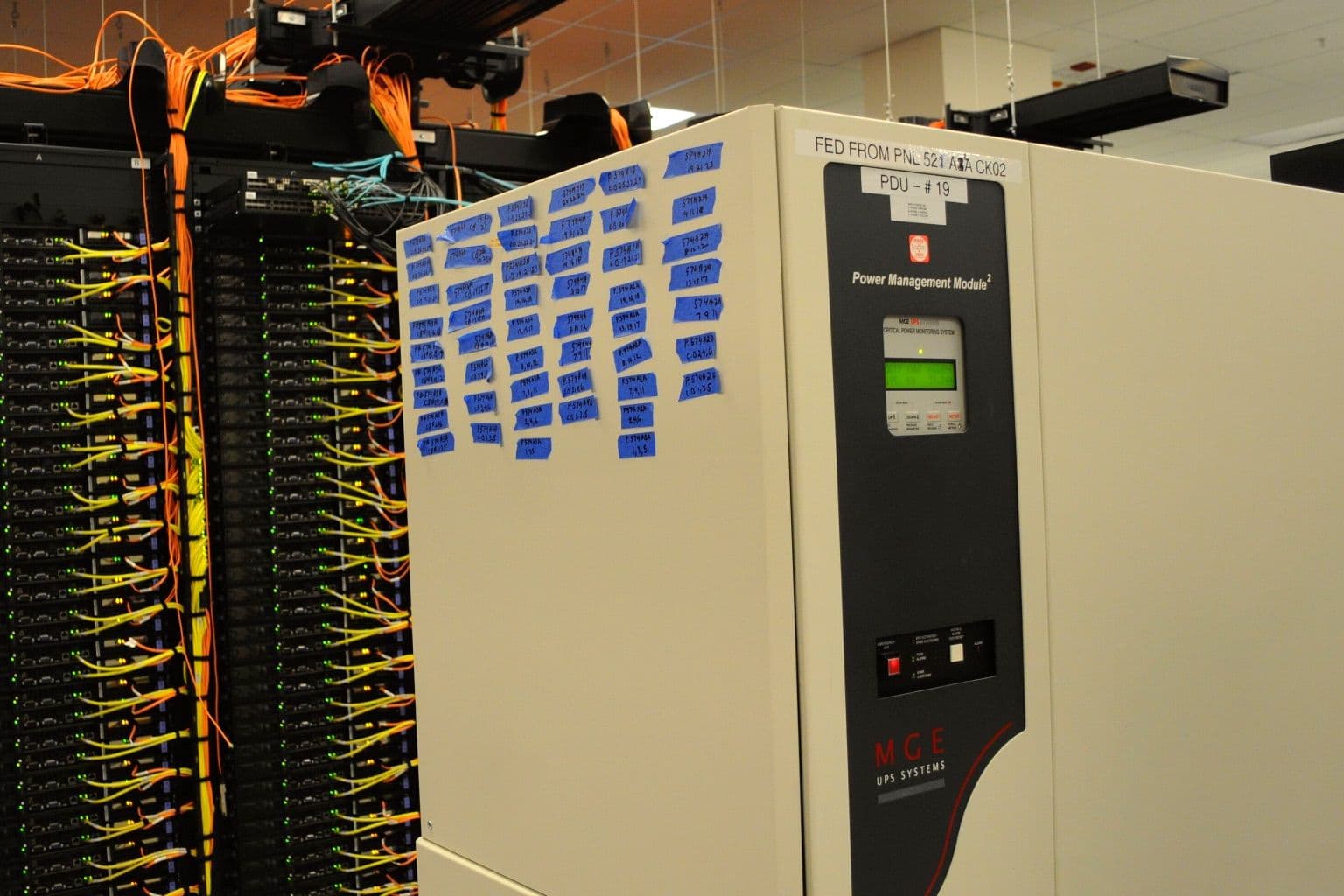
Cover photo: UPS Power Management Module, racks with network cabling in NERSC data center, via Wikimedia Commons (CC0).