What a 5G Router Is Good For in a UAE Business
A 5G router earns its keep in three situations: getting a new Dubai office working on day one while the fibre circuit is still being provisioned, carrying a second WAN path that avoids your fibre riser, and serving a site that will be packed up again in six months. It is a weak choice as the only link into an office that needs anything reaching it from outside, because UAE mobile data sits behind carrier NAT. The rest is two radio bands, four antenna ports and a regulator's registration list.
Two bands carry almost all of it
The TDRA has assigned 300 MHz of n78 spectrum from 3300 MHz to 3600 MHz to e&, and 200 MHz from 3600 MHz to 3800 MHz to du. That 3.5 GHz block is where UAE 5G capacity lives. Below it sits 700 MHz, which travels further and gets indoors more easily but carries less. The TDRA also gave e& and du 1 GHz each of millimetre wave spectrum in the 25.5 to 27.5 GHz range in 2021.
For a business router the millimetre wave allocation is a footnote. Cisco's 5G Sub-6 GHz pluggable, the P-5GS6-GL, supports FR1 bands including n28 and n78, runs an FN980 modem, needs IOS XE 17.7.1 or later, and Cisco's configuration guide states that "Cisco pluggable modules do not support mmW (FR2) bands at this time." The two bands serving your office are n78 for throughput and n28 at 700 MHz when the building fights you.
Coverage claims need care. du announced 98.5 percent 5G population coverage across the UAE on 12 October 2023, and population coverage is measured outdoors. It says nothing about the signal inside a tower in Business Bay.
The building takes more signal than the distance does
Recommendation ITU-R P.2109-2, approved in August 2023, models building entry loss and sorts every building into two classes. A "traditional" building has no thermally efficient materials. A "thermally-efficient" one has, in the ITU's words, metallised glass and foil-backed panels.
Run the model's published coefficients at 3.5 GHz with the path horizontal and the median building entry loss comes out at about 15.7 dB for a traditional building and about 30.9 dB for a thermally efficient one, reaching roughly 49 dB at the ninetieth percentile. Towers in DIFC, Business Bay and JLT use solar control coated glass for a reason, and that reason is the Dubai sun. The same coating is a reflector at 3.5 GHz.
That gap of roughly 15 dB is the whole argument about antenna placement. A router in a comms room at the core of the floor, with stub antennas screwed into its faceplate, sits in the worst position in the building. Moving the antenna to a window, or outside with coax running back, turns an unusable link into a working one.
Four antenna ports, and only two of them transmit on n78
The P-5GS6-GL faceplate carries four SMA antenna connectors numbered ANT 0 through ANT 3, a GPS SMA, and two SIM slots. Installers treat the four as interchangeable, and Cisco's RF band mapping table says they are not. ANT 0 transmits on fourteen 5G bands including n28 at 700 MHz, and n78 is absent from that list. ANT 1 transmits on n5, n48, n77, n78 and n79. ANT 2 transmits on ten bands including n41, n66, n77, n78 and n79. ANT 3 is receive only.
Read that against the UAE's spectrum and the rule falls out. Your n78 uplink depends on ANT 1 and ANT 2, and your n28 uplink on ANT 0, the one port that cannot transmit on n78. Fit two antennas and pick wrongly and you get a strong downlink, a collapsing uplink, and a fault that looks like a carrier problem for a week. Cisco's four-port antenna, the 5G-ANTM-O-4-B, maps its Main 0, Main 1, Div 0 and Div 1 leads to ANT 0 through ANT 3 in that order. Label the coax at both ends.
Standalone decides which part number you order
3GPP Release 15 introduced standalone 5G with a new core, and Release 16 completed at the TSG#88e plenary on 3 July 2020. Standalone makes network slicing possible, and slicing is the only honest answer to a business wanting a performance commitment on mobile. e& UAE launched the region's first commercial 5G slicing product for business customers on 20 May 2025 over its standalone network, describing end to end reserved capacity and traffic isolation. No speed or latency figures were published with it.
That matters at the order stage. Cisco's Catalyst 8200 datasheet lists two sub-6 pluggables: the P-5GS6-GL, "5G Sub-6 GHz Pluggable, Global", and the P-5GS6-R16SA-GL, "5G Sub-6 GHz Pluggable, 5G SA Global". If you expect to buy a slice, specify the standalone part. Swapping later means a site visit, a reconfiguration and a second round of antenna work.
What carrier NAT quietly removes
RFC 6598, published in April 2012, reserved 100.64.0.0/10 as Shared Address Space for carrier-grade NAT, numbering the link between the carrier's NAT and customer equipment. The RFC is explicit that packets carrying these addresses "MUST NOT be forwarded across Service Provider boundaries" and that the space is not globally routable. If your router picks up an address in that range, no public address points at your office.
That removes four things people assume will work: port forwarding to an NVR so a manager can watch cameras from home, a site to site VPN in which the 5G end has to answer rather than dial, any public facing server, and remote access tools expecting an inbound session. Everything starting from inside works normally, which is why a 5G link suits an SD-WAN transport and fails as a bare circuit with services behind it. If you need inbound reachability, get a public static address from the operator in writing before ordering.
Heat is where this fails in August
The Cisco Catalyst 8200 series is rated for an operating temperature of 0 to 40 degrees Celsius. A comms room in a Dubai tower with the floor's split units off from Friday evening to Sunday morning does not stay inside that band, and a cellular modem at full duty adds its own heat to a cupboard sized for a patch panel and a switch. The failure is rarely dramatic: throughput sags, the modem resets, and nobody links it to the air conditioning schedule. That rating covers the chassis only, so an antenna on a roof in Jebel Ali or Dubai Silicon Oasis needs outdoor rated parts, a gland and a drip loop priced into the job.
Type approval is a real gate
The TDRA requires radio and telecommunications terminal equipment to be registered before it is used, sold or distributed in the UAE. Equipment is graded into three risk levels: Level 1 uses a Declaration of Conformity with no inspection, Level 2 is inspected where the TDRA asks, and Level 3 needs proof of conformity against the technical standards plus inspection. Approvals run three years and are renewable.
A cellular router is a transmitter, so it sits inside that regime, and a unit bought from an overseas reseller may carry no UAE registration. The TDRA publishes its approved equipment list, so the claim can be checked rather than assumed. More in our note on genuine versus grey market IT hardware in the UAE, and the regulator's wireless rules in the TDRA rules every UAE office Wi-Fi project should know.
Where it fits in a design that already works
| Use | Why 5G suits it | Check before committing |
|---|---|---|
| New office before fibre delivery | Working the day the SIM is activated | Signal measured at the comms room, not the lobby |
| Second WAN path | Avoids the building riser and the civil route | Failover tested under load, not by unplugging a cable |
| Temporary site or exhibition stand | No circuit order, no reinstatement cost | Antenna mounting permitted by the venue |
| Branch with no economic fibre route | Avoids a civils quote larger than the site value | Whether anything there needs inbound access |
The Catalyst 8200 carries one pluggable module slot per chassis, so one router gives you one radio. Cisco's datasheet notes that a pluggable module and an external cellular gateway can work in tandem as an active-active cellular WAN, which is how you get two radios without two routers. Your encryption ceiling is a separate number: the C8200-1N-4T is rated up to 1 Gbps of IPsec throughput and the C8200L-1N-4T up to 500 Mbps, against 3.8 Gbps of plain IPv4 forwarding. On a busy link the tunnel, not the radio, is often the limit. If the link is a backup, the real design work is failover behaviour, covered in making dual ISP in Dubai actually fail over. If it is one transport among several across sites, see SD-WAN for UAE businesses with more than one site.
What to send when you ask for a quote
Codeeo Tech supplies the routing hardware this runs on, including Cisco and Juniper, every item quoted on request rather than listed at a price. We do not sell SIMs or operator plans, so a slice or a static address comes from e& or du. Five answers decide the module, the antenna and the chassis: the room the router sits in, whether an antenna can reach a window or a roof, which operator the site uses, whether anything must accept inbound connections, and whether the link is primary or backup. Send those through the contact page and we will quote against them.
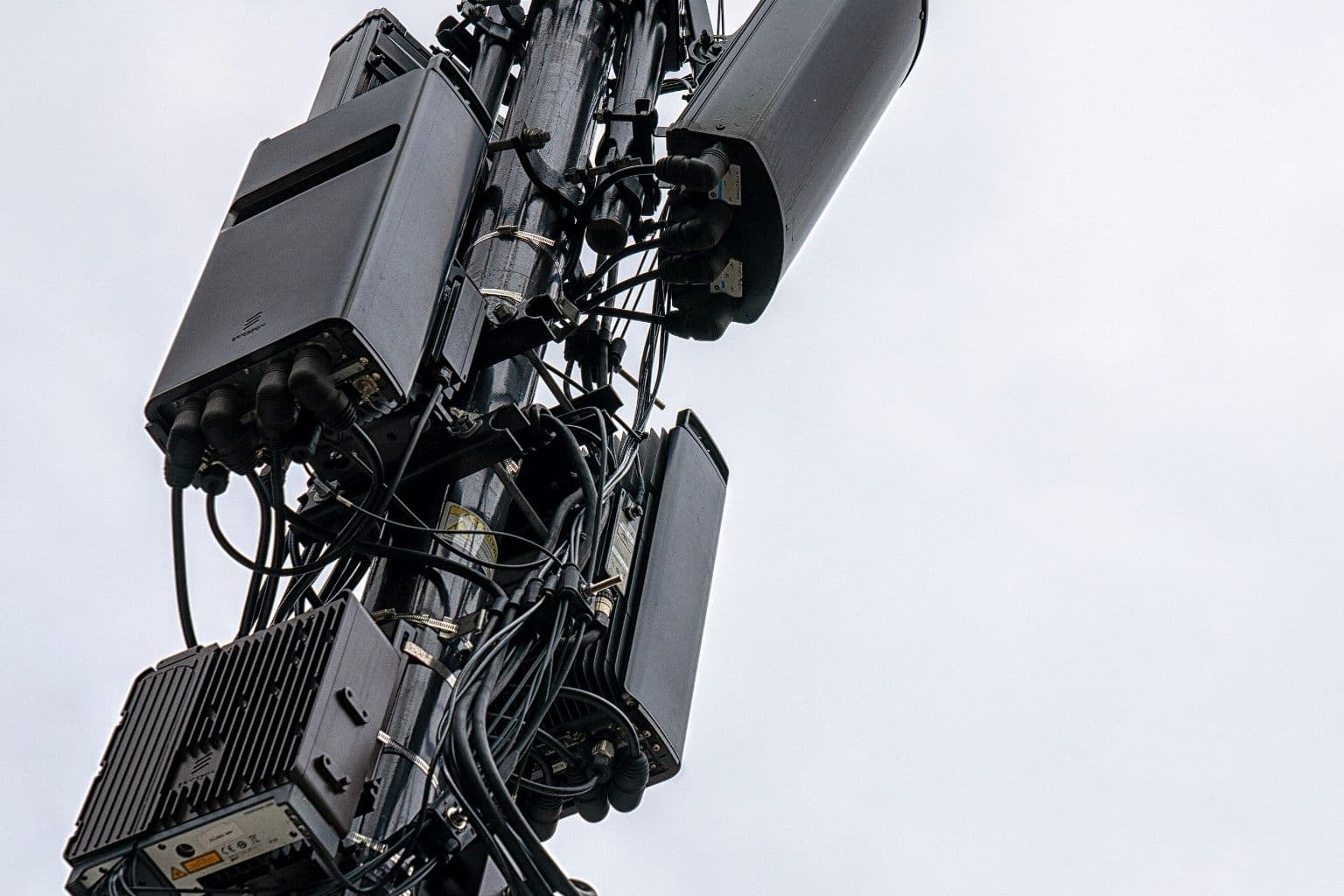
Cover photo: Cellular 5G Equipment - Cell Tower Antennas by Tony Webster, via Wikimedia Commons (CC BY 2.0).