Blade, Rack or Tower Servers: Which Suits a UAE SME
Most UAE businesses under a few hundred staff should buy rack servers, and a fair number should buy towers. Blades solve a density and cabling problem that a company running four or five servers does not have, and they bring a chassis dependency that is hard to unwind later.
Here is what separates the three formats in practice.
Tower
A tower server stands on the floor like a large desktop. It runs quieter than rack equipment, tolerates a normal room, and needs no rack, no rails and no cabinet.
That makes it right for a business running one or two servers with nowhere proper to put them: a clinic, a showroom, a small professional firm, a site office. Many models are also available in rack form, so a tower bought today can often be converted later with a conversion kit rather than replaced.
The limits show up with growth. Three towers scattered in a cupboard is harder to power, cool, cable and secure than three rack units in a cabinet, and physical security is frequently the weakest part: a server anyone can carry out of the building is a data protection problem, not just a hardware one.
Rack
Rack servers are the default for a reason. They sit in a standard 19 inch cabinet, measured in rack units, with 1U and 2U covering most business workloads. A 2U unit gives you more drive bays, more expansion slots and better cooling headroom than a 1U, and for most UAE SMEs the 2U is the more practical buy.
Rack format brings the things that make an estate manageable: structured cabling, managed power distribution, a single protected power feed, lockable doors, and a sensible place to put the switch, the firewall and the UPS. It is also how you grow without redesigning, since adding a fourth server means adding a unit rather than finding floor space.
The requirements are real, though. Rack equipment is loud, so it needs a comms room rather than an office corner. It needs the cabinet, the rails and the power distribution, all of which are separate line items. It needs cooling that does not depend on building air conditioning running at the weekend, which in a Dubai summer is not a theoretical concern.
Blade
A blade system is a chassis holding multiple server modules that share power, cooling, network and management. The density is excellent and the cabling reduces dramatically, because the chassis carries the connectivity rather than each server.
Blades make sense when you are running many servers in a constrained space, when cabling and power efficiency at scale genuinely matter, and when the workload justifies the chassis. The break even is usually somewhere around eight or more servers, and below that the chassis cost dominates.
There are trade-offs to go in with your eyes open. The chassis is a shared dependency, so its power, cooling and management have to be right. Expansion is bounded by the chassis you bought. Blades typically carry fewer local drives than rack servers, which pushes you toward shared storage and adds another system to buy and run. And you are committed to one vendor's chassis generation for the life of that system.
How to choose without overthinking it
- One or two servers, no rack, no comms room: tower, and plan for a lockable location with ventilation.
- Two to eight servers, or any business with a comms room: rack, mostly 2U, in a proper cabinet with managed power.
- More than eight servers with space or cabling constraints: evaluate blades against rack, including the storage you will need alongside.
- Heavy compute in a small footprint, such as AI or rendering: look at dense rack platforms and GPU capable chassis rather than assuming blades.
- Growing quickly and unsure: rack, every time. It is the format with the fewest decisions you cannot reverse.
The costs that sit outside the server quotation
The format changes more of the project budget than people expect.
- Cabinet, rails and power distribution for rack and blade, which are separate items and often forgotten until installation day.
- Cooling. Denser equipment concentrates heat. A blade chassis in an uncooled cupboard will throttle or shut down, and in UAE conditions that happens sooner than the specification suggests.
- Power protection, sized for the real load and the runtime you need for an orderly shutdown. Our guide to UPS and power protection for Dubai offices covers the sizing and the battery life problem in this climate.
- Networking. Blade chassis integrate switching modules that have to match your existing network. Rack servers just need switch ports, which is simpler.
- Noise and location. If the only available space is an occupied office, that decides the format for you.
Sizing comes after format
Once the format is settled, the specification follows the workload: memory first, cores rather than clock speed for virtualised work, enterprise drives in a redundant configuration, dual network ports and out of band management. That order is set out in our business server buying guide for UAE SMEs.
One rule cuts across all three formats. Two ordinary servers beat one remarkable server, because the second one is what keeps the business running when the first one fails.
Codeeo Tech supplies tower, rack and blade platforms from HPE, Dell EMC, Supermicro and Lenovo, along with the cabinets, power and switching they need, to businesses across the UAE. Tell us the workload and where the equipment will live through the contact page and we will recommend the format before the model.
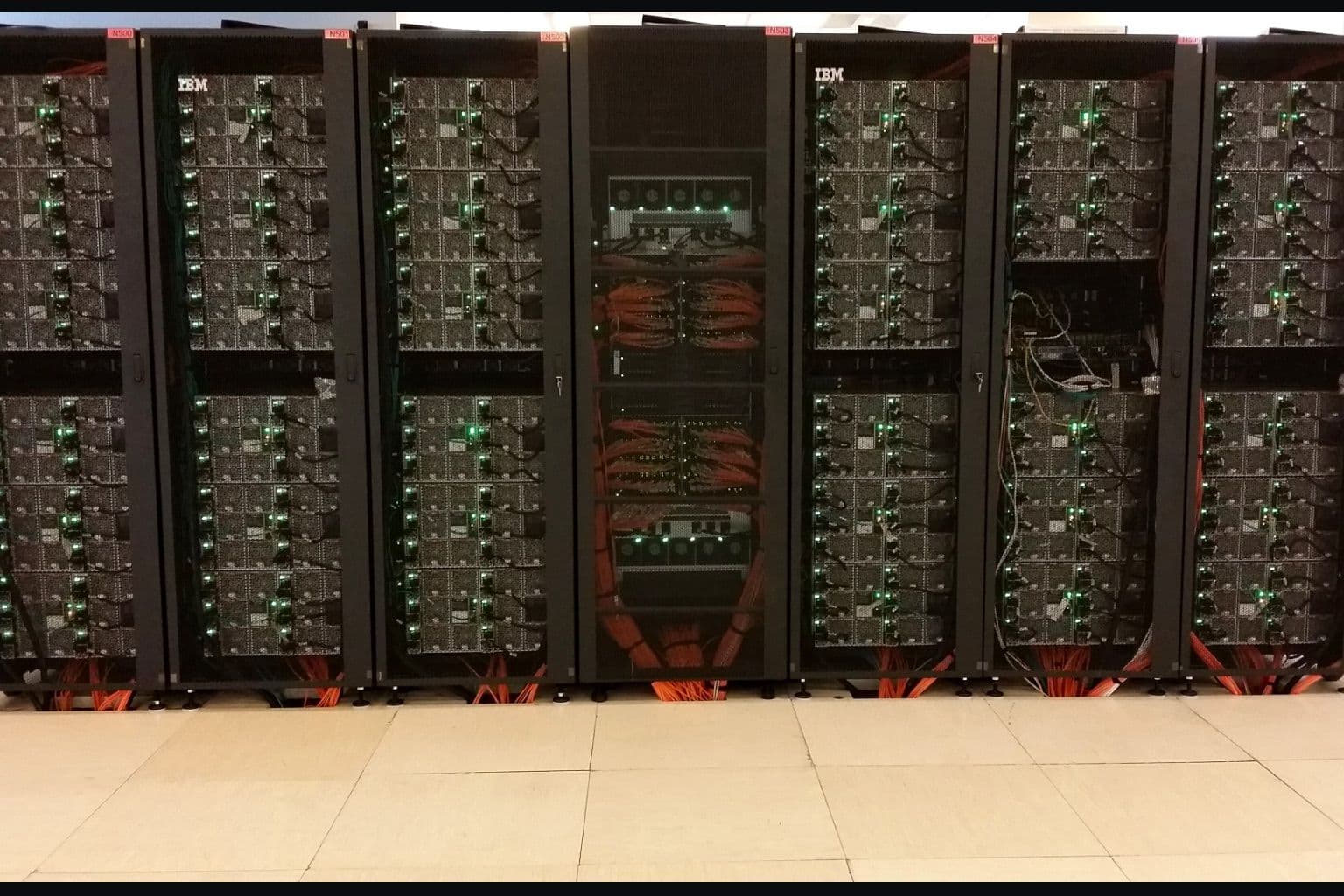
Cover photo: Galileo supercomputer rack by CINECA, via Wikimedia Commons (CC BY 2.0).