Headsets, Speakerphones and Room Audio: Where the Money Matters
Across a desk headset, a portable speakerphone and a room audio kit, almost all of the money that changes what people experience goes into two parts: the microphone, which decides what the far end hears, and the radio, which decides whether the device works reliably. In the UAE the radio comes first, because the same headset is sold on two DECT bands and only one is authorised here. The band is printed in the product name.
The DECT band is printed in the product name
HP sells one headset family on two radios and says so in the title. The datasheet published in March 2025 for product 77Y82AA is called Poly Savi 8220 UC Microsoft Teams Certified DECT 1920-1930 MHz USB-A Headset. On HP's Middle East store the comparable item is part 8D3F1AA, Poly Savi 8210 UC Microsoft Teams Certified DECT 1880-1900 MHz USB-A Headset. The 1920-1930 MHz build is the North American radio.
The UAE position is written down. The TDRA Regulations for Ultra-Wide Band and Short Range Devices, Version 5.0, dated 30 October 2023, list 1880 MHz to 1900 MHz for DECT applications including cordless telephony, at a nominal transmit power of up to 250 mW, referenced to EN 300 175. TDRA Technical Specification TS RE 004, Version 1.0, dated 3 July 2019, requires DECT handsets and ancillary equipment to sit inside the bands at entry UAE 20 of the National Frequency Allocation Table and to meet EN 301 406, with EN 301 489-1 and 489-6 for electromagnetic compatibility.
What goes wrong is quiet. Someone orders from a US web store, the base pairs first time, the headset works at the desk, and nobody looks at the band again until a compliance question lands. Reading the band is the same discipline as checking that hardware came through the official channel, and it costs nothing. There is no performance reason to hesitate: the US document for the 8200 UC series quotes 590 ft in open area and 180 ft in a typical office, while EMEA documents quote 180 m and 55 m, the same distances in different units.
The microphone is the only part the far end hears
Microsoft publishes a designation that answers the open-plan question. On its Learn page Phones and Devices for Microsoft Teams, dated 1 October 2024 with device tables refreshed in September 2026, the Premium Microphone for Open Office designation marks headsets tested to carry the wearer's voice while keeping neighbouring desks out of the call. HP calls the same behaviour close conversation limiting noise cancellation.
It matters more in Dubai than the spec sheet suggests. A typical Business Bay or JLT fit-out is a bench run with 1.2 m screens, glass partitions and a hard ceiling, which gives speech little to absorb it. The headset speaker satisfies one person. The microphone has to satisfy everyone else, in a room built from reflective surfaces.
Bandwidth figures need context. The Savi 8220 UC datasheet lists a microphone bandwidth of 100 Hz to 10 kHz and a speaker bandwidth of 100 Hz to 6.8 kHz in wideband mode, rising to 20 Hz to 20 kHz in multimedia mode. Same hardware, two jobs. The call then caps it: ITU-T Recommendation G.722 covers wideband speech across 50 Hz to 7000 Hz, against conventional telephony at 300 Hz to 3400 Hz. A wideband headset bridged onto a narrowband trunk sounds narrowband.
Two certification labels sit in the same table
Microsoft's device list carries two labels that buyers read as one. Certified for Microsoft Teams is not the same entry as Skype for Business with upgrade to Microsoft Teams. The Savi 8210, 8220, 8240 and 8245 Office and UC models, qualified on 20 April 2020, sit under the second. Newer HP Poly entries carry the first: Focus 620/625 on 20 April 2026, Mission 410/415 on 12 December 2025.
Certification buys a defined list: automatic default device selection, call control for answer, hang up, mute and volume on PC and Mac, wideband audio with echo cancellation, no provisioning work, and firmware updates. One limitation on the same page catches standardisation projects. Teams does not support button controls on certified peripherals while third-party conferencing applications are running at the same time. On desks that keep Teams and Zoom open all day, the hardware answer button stops working, and that button is often what justified the upgrade.
Where the money goes in a speakerphone
HP's datasheets for one family make the ladder easy to read. The Poly Sync 20, product 772D2AA, dated March 2025, has a three-microphone array, pickup up to 2 m (7 ft), microphone bandwidth 100 Hz to 7.8 kHz, a 40 mm speaker and up to 20 hours of talk time. The Poly Sync 40, product 772C4AA, dated September 2026, has a three-microphone steerable array, pickup up to 2.5 m (8 ft), a 50 mm speaker, up to 30 hours of talk time and wireless daisy chaining. The Poly Sync 60, product 772C2AA, dated July 2024, moves to six microphones at 100 Hz to 6.7 kHz, twin 50 mm speakers, Bluetooth 5.1 reaching up to 30 m, daisy chaining and a USB video camera input.
Read that honestly and the pricing logic changes. Going from the Sync 20 to the Sync 40 buys 500 mm of extra pickup radius, ten more hours of battery and the ability to pair two units. The reach barely moves. The step that changes how a room behaves is three microphones to six, because an array that size holds a table instead of a huddle. Microsoft also tests shared devices at certification against defined room sizes, which makes the published room size a better buying signal than the price gap.
A 2.5 m pickup radius does not cover a 3.5 m boardroom table seating eight. Either daisy chain two units or accept that the room needs a fixed system, a different conversation about what makes a meeting room kit people actually use.
Dongle or native Bluetooth
Microsoft is frank here. Most Bluetooth headsets certified for Teams are designed around a USB dongle. Natively certified devices are supported on Windows PCs, with macOS a possible future addition, and Microsoft states that some users will still need the dongle in three cases: a high-density radio environment, a PC whose Bluetooth radio already carries several paired devices, or a PC with a poor performing radio.
A tower floor in Business Bay with a dense access point layout and several hundred clients is the first case. Bluetooth shares 2400 MHz to 2483.5 MHz with Wi-Fi, the band the same TDRA table allocates to non-specific devices at 10 mW e.i.r.p. DECT at 1880 MHz to 1900 MHz sits clear of it, which is the argument for DECT on a reception or support desk. It is the congestion story behind office Wi-Fi that feels slow while the line is fine.
The hearing protection may be switched off
The footnote on the Savi 8220 UC datasheet of March 2025 describes SoundGuard Digital as limiting sound below 118 dBA against acoustic shock, adding G616 anti-startle protection that holds noise below 102 dB SPL per the Australian Communications Industry Forum G616 recommendation, and measuring daily exposure so the time weighted average does not exceed 80 dBA or 85 dBA. The same footnote adds that these features require the Poly Lens Desktop App.
That last sentence is the one to act on. On a freshly imaged laptop with no vendor management app deployed, the protection you paid for is not running. If headsets are going to a support desk or sales floor, put the management software into the deployment image and verify it on one machine first.
If desk phones are in scope
Cisco orders its Headset 500 Series by regional suffix, and the data sheet dated 17 October 2024 lists CP-HS-WL-561-S-US= for the United States and Canada, the -EU= variant for Europe and Asia, and -LA= for Latin America. It quotes range up to 100 metres (333 feet), up to 10 hours of active use, 60 hours of standby and 200 days in storage.
The line most people miss sits in that data sheet: the Headset 560 Series Multibase is incompatible with Cisco IP Phone 7800 Series phones using Power over Ethernet. Most 7800s in a UAE office are PoE powered, so this pairing needs a different base or local power. Confirm the power source during the survey, and settle which PoE class each device draws before the order goes out.
What to send with a quote request
- The call platform in use: Microsoft Teams, Zoom, Webex, or an on-premises PBX and the codecs it supports.
- For every DECT line, the band written out as 1880-1900 MHz, so nobody quotes the 1920-1930 MHz build.
- Headset counts by setting: open-plan bench, private office, reception, support desk. The bench count needs the open office microphone designation.
- For each meeting room, the table length in metres and the seat count, not the room name.
- The connector on the laptops, USB-A or USB-C, and whether desk phones are in scope.
- Whether the vendor management app will be deployed, since acoustic protection depends on it.
Those six points remove most of the back and forth, because they pin down the radio, the room and the software. You can see the Poly and Polycom equipment Codeeo Tech lists on the Poly category page, and every item is quoted rather than priced, so send those six lines through the contact form.
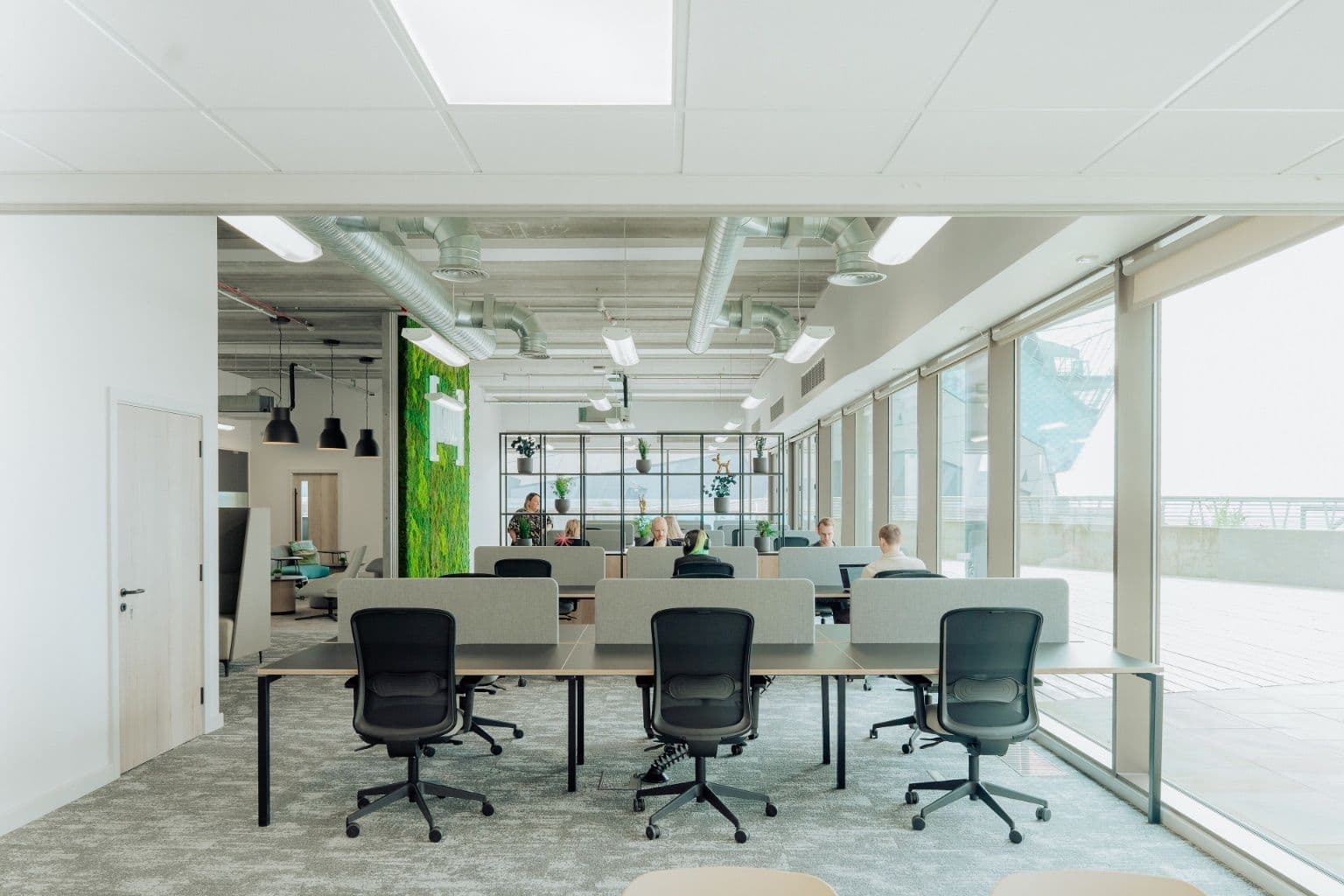
Cover photo: C4DI interior coworking space 2025 by Influence Media, via Wikimedia Commons (CC BY 4.0).