Indoor or Outdoor Access Points for UAE Sites and Warehouses
Buy an outdoor-rated access point wherever the unit itself will sit in the weather or in a space that is not air conditioned. In the UAE that second condition catches more sites than the first. A steel-roofed warehouse in Jebel Ali, a loading bay in Dubai Investments Park, a labour camp corridor in Mussafah and a car park in Al Quoz all run hotter in August than an indoor access point is built to survive, and heat kills far more access points here than rain ever will.
The deciding number is temperature, not rain
Indoor access points are specified for a conditioned office. Cisco's data sheet for the Catalyst 9166 series, updated 1 September 2026, gives the 9166D1 an operating range of minus 20 to 50 degrees Celsius at 10 to 90 percent humidity, non-condensing. That is a normal indoor figure across the industry.
Now set it against the climate. The National Centre of Meteorology recorded 51.8 degrees at Sweihan at 3pm on Friday 1 August 2025, as reported by Khaleej Times that day. Air under a sun-loaded metal roof with no cooling sits well above the shade reading outside. An indoor unit on a purlin in an unconditioned warehouse spends every summer afternoon outside its design envelope. It fails in year two, as a radio that reboots at 2pm and is fine by 6pm, which the help desk logs as a software fault.
Outdoor units carry a wider envelope and, more importantly, two ratings. Cisco's Catalyst 9163E data sheet, also dated 1 September 2026, lists minus 40 to 65 degrees Celsius without solar derating and minus 40 to 55 degrees with solar derating. The second figure is the honest one for a unit in direct sun: on a shaded wall or under a canopy you have 65, on an open pole at noon you have 55. Both clear a Dubai summer. The indoor unit's 50 does not.
What the IP rating really buys you here
Ingress protection ratings come from IEC 60529: the first digit is solids, the second is water. The 9163E is rated IP67, meaning dust tight and able to survive temporary immersion. In the UAE it is the dust digit that matters, because the enemy at a Jebel Ali yard or a Dubai Industrial City plot is fine sand carried on the shamal, and a vented indoor housing will fill with it inside a season.
Two more lines on the Cisco sheet are worth checking on any outdoor unit: wind resistance of 161 km/h sustained and 266 km/h gusts, and humidity of 5 to 95 percent non-condensing. Non-condensing is the catch on the coast. A unit carried out of a 20 degree store and bolted up on a humid 40 degree morning in Al Hamriyah will sweat inside the housing, so let it reach ambient before you seal the gland.
Antennas decide whether a warehouse gets coverage
This is where most UAE warehouse Wi-Fi projects go wrong, and it has nothing to do with weatherproofing. An omnidirectional access point bolted to the roof deck above 12 metre racking radiates most of its energy sideways across the top of the shelving, where nobody is, and very little down the aisles where the scanners and forklifts are. The site looks covered on a heat map taken with the racks empty, then loses the far aisles the week the stock arrives.
Vendors build for this. Cisco's 9166D1 is an indoor unit with a built-in directional array described in the data sheet as designed for high ceilings such as auditoriums, warehouses and other large open space areas, with a 6 dBi, 70 by 70 degree pattern on 2.4 and 5 GHz and an 8 dBi, 60 by 60 degree pattern on 6 GHz. Mount it high, angle it down the aisle, and the energy goes where the devices are. HPE Aruba Networking's 670 series outdoor family splits the same way: the data sheet lists the AP-675 with integrated omnidirectional antennas, the AP-677 with a directional pattern of roughly 90 by 90 degrees, and the AP-679 with a selectable 30 by 30 degree mode for long throws.
For anything unusual, buy the connectorised model and choose the antenna separately. The Aruba AP-674 exposes two N-type dual band connectors for 2.4 and 5 GHz and two N-type connectors for 6 GHz. The Cisco 9163E exposes four N-type connectors and ships with no antennas at all, so an omni dipole or a directional patch is a line item on your order. That is the model for a yard gate, a weighbridge or a fuel station canopy. The trade-off is that a 60 degree beam aimed two racks off centre misses the aisle entirely, so survey the mounting points with the racking plan in hand. Our note on what a wireless site survey tells you before you buy covers how.
TDRA rules that change an outdoor design
The regulatory text is TDRA's Regulations for Ultra-Wide Band and Short Range Devices, Version 5.0, dated 30 October 2023. Its table for wireless access systems sets a different ceiling in each part of the 5 GHz band: 200 mW e.i.r.p. in 5150 to 5250 MHz, 100 mW rising to 200 mW with transmit power control in 5250 to 5350 MHz, 500 mW rising to 1 W with transmit power control and dynamic frequency selection in 5470 to 5725 MHz, and 2 W per 10 MHz channel or 4 W per 20 MHz channel in 5725 to 5875 MHz.
Three consequences follow. First, range across a yard lives in the upper band, so a policy that pins outdoor radios to the lower channels throws away most of your allowed power. Second, the 5470 to 5725 segment requires radar detection; near Jebel Ali or Al Maktoum airport, expect occasional channel moves. Third, and this catches buyers of Wi-Fi 6E kit, the same table lists 5945 to 6425 MHz as in-building only at 200 mW, with a footnote that emissions must not exceed 200 mW measured 10 metres from the building or the boundary of the premises.
So a tri-band outdoor access point is, under current UAE rules, a dual-band access point once it is outside. Cisco's 9163E sheet says 6 GHz outdoor operation depends on local regulatory approval, and Aruba's 670 sheet notes the AP only enables its 6 GHz radio once standard power requirements are met and the radio is authorised, with 2.4 and 5 GHz working regardless. Buy Wi-Fi 6E outdoor for the better 5 GHz radio and the 2.5 Gbps uplink, not for the 6 GHz band. The wider rule set is in TDRA wireless rules every UAE Wi-Fi project should know.
Power and cabling to the outdoor unit
Outdoor radios want more power than the ceiling-tile assumption. The Cisco 9163E draws up to 25.5 W on an 802.3at PoE+ port and runs its uplink at 2.5 Gbps; on a plain 802.3af port it is limited to 14 W and the link drops to 1 Gbps. The Aruba 670 series is listed as an Ethernet Alliance Class 6 powered device. Check the switch budget for every outdoor port before you order, and read PoE standards explained for UAE office networks if the class numbers are new to you.
The cable run matters as much as the switch. A 100 metre channel that was fine on paper becomes 108 metres once the installer routes around a roller shutter. Use UV-stable jacketed cable in conduit outside, fit a surge protector where the cable enters the building, and bond the unit to earth as the installation guide says, because a surge that is not stopped there takes the switch port with it. Our post on cabling shortcuts that cost more than they save lists the usual ones.
Where UAE projects go wrong in practice
- Omnis on the roof deck. Energy across the top of the racking, nothing in the aisles. Use directional units angled down, or external patches.
- Mounting in direct sun with the 65 degree figure in mind. The derated figure is 55. A shade plate is cheap insurance.
- Expecting 6 GHz outdoors. In-building only under the current regulations. Plan the yard on 5 GHz.
- Powering from an old 802.3af switch. The radio comes up on a 1 Gbps link with reduced power, and nobody notices until the throughput complaint.
Which to buy, by location
| Location | Type | Why |
|---|---|---|
| Air conditioned office, showroom, mezzanine | Indoor, integrated omni | Within the 50 degree indoor envelope |
| Warehouse floor, cooled, high racking | Indoor, directional array | Beam down the aisles; the 9166D1 class of unit is built for this |
| Warehouse floor, not cooled | Outdoor-rated, directional | Summer floor temperature exceeds the indoor spec even under a roof |
| Yard, loading bay, car park, gatehouse | Outdoor, connectorised with external antennas | Omni or patch per spot; dust-tight housing; mount shaded |
| Fuel, chemical or oil and gas site | Outdoor, hazardous-location variant | Aruba's 670EX models carry ATEX Zone 2 and IECEx listings |
Every figure above is a laboratory number. The site that tests them is a Dubai yard on a Friday afternoon in August, so put a temperature logger on the mounting point for a week in summer before you buy. Nothing on a data sheet replaces that reading.
Codeeo Tech supplies indoor and outdoor wireless from Cisco and HPE Aruba Networking, with the PoE switching behind it. Send the site plan and racking layout through the contact page, and we will come back with a model and antenna list for each zone rather than one part number for the whole building.
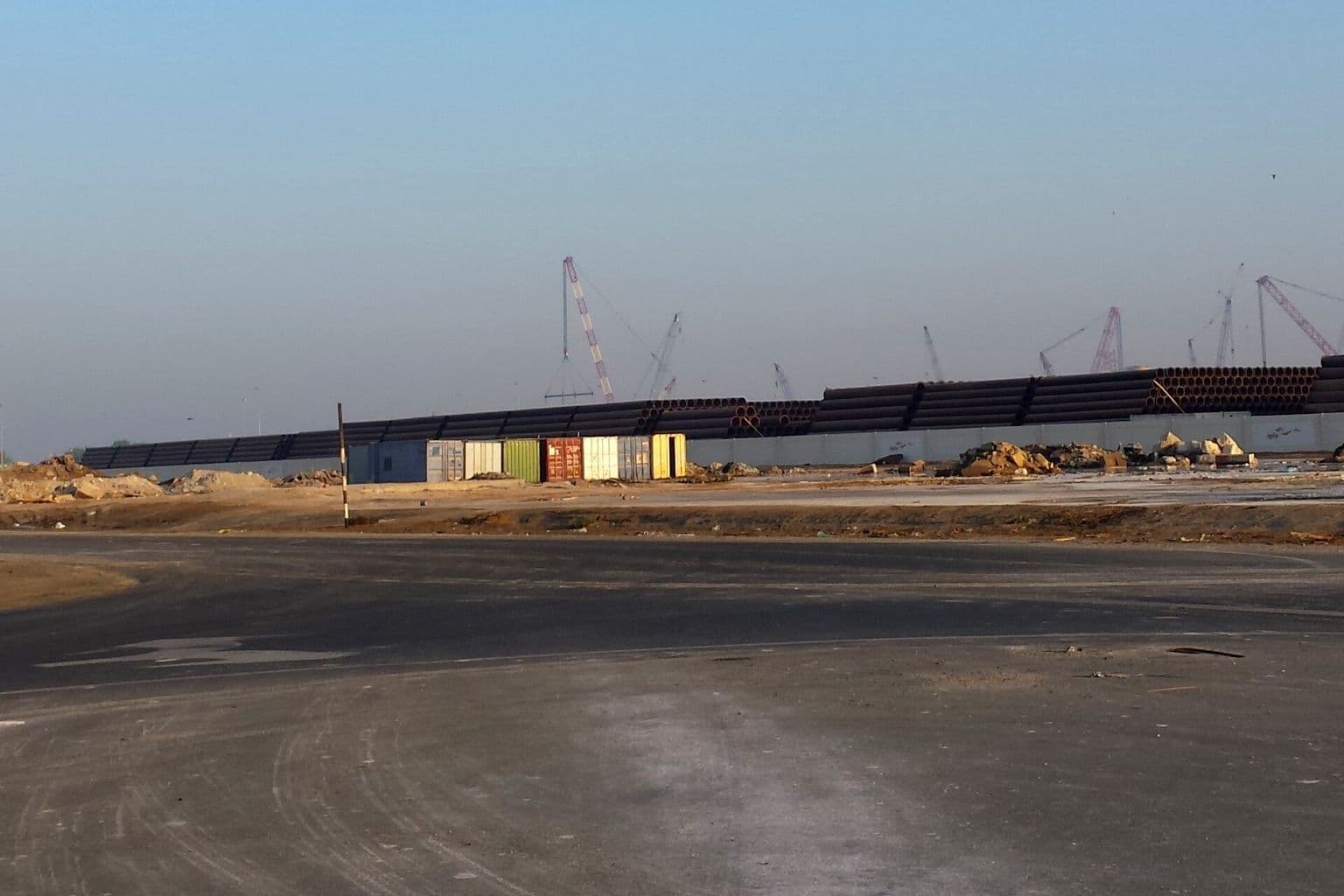
Cover photo: Mussafah Sanaya - Abudhabi - UAE - panoramio (11) by Rizwan Ullah Wazir, via Wikimedia Commons (CC BY 3.0).