VA or Watts? Reading a UPS Nameplate Properly
A UPS nameplate carries two power figures because it has two separate limits, and you are allowed to exceed neither. VA is apparent power, the voltage multiplied by the current the unit can push. Watts is real power, the energy the unit can actually deliver. On the servers, switches and firewalls sold today, the watt figure is the one you run out of first, so that is the number to size against.
Schneider Electric White Paper 15, "Watts and Volt-Amps: Powerful Confusion" by Neil Rasmussen, puts the division of labour plainly: the watt rating determines the power you buy from the utility and the heat the equipment generates, while the VA rating is what you use to size wiring and circuit breakers. The ratio between the two is the power factor. That single sentence resolves most of the arguments that happen between an IT manager and a fit-out electrician in a Business Bay tower.
Three real nameplates, three different power factors
The quickest way to see why a rule of thumb fails is to line up three units from the same vendor. These figures were read from Schneider Electric product pages on 16 September 2026.
| Model | VA | Watts | Power factor |
|---|---|---|---|
| APC Smart-UPS SMT1500I, line interactive | 1500 VA | 1000 W | 0.67 |
| APC Easy UPS On-Line SRV3KI, double conversion | 3000 VA | 2400 W | 0.8 |
| APC Smart-UPS Ultra SRTL3KRM1UINC, lithium-ion | 3000 VA | 3000 W | 1.0 |
Two of those units carry the same 3000 VA headline and differ by 600 W of usable output. If a supplier quotes you "a 3 kVA UPS" and nothing else, you have been told almost nothing about what it will carry. Ask for the watt figure in writing before you compare two quotations, the same way you would check every other line on an enterprise hardware quotation.
Why modern kit hits the watt limit first
White Paper 15 explains the mechanism. Equipment built with a capacitor input switching supply has a watt rating in the range of 0.55 to 0.75 times its VA rating. Equipment built with a power factor corrected supply has a power factor of 0.99 to 1.0, so its watt and VA numbers are effectively the same. The paper notes that large computing equipment such as routers, switches, drive arrays and servers made after roughly 1996 uses the corrected design.
That is not a vendor preference, it is regulation. IEC 61000-3-2, Edition 5.0, published on 26 January 2018, sets limits on harmonic current emissions for equipment drawing up to 16 A per phase, which is what pushed the industry to power factor correction in the first place. The practical consequence for a Dubai Silicon Oasis comms room: a rack of current generation servers draws close to one watt for every volt-amp, so a 3000 VA unit rated at 2400 W will refuse a 2600 W load even though the VA arithmetic looks fine.
The runtime number that assumes a smaller load than yours
This is the trap that costs people an orderly shutdown, and it is the reason to read the fine print under a runtime chart. Schneider Electric White Paper 17, "Understanding Power Factor, Crest Factor, and Surge Factor", also by Neil Rasmussen, sets out the problem: battery runtime is dictated by the watt load, but when manufacturers quote runtime at full load they are often quoting full VA load.
The paper works the example. A UPS rated at 10,000 VA is advertised with 20 minutes of runtime at full load. The small print reveals that full load means a 0.65 power factor, so the test load was 6500 W against a 9000 W rating, which is 72 percent of the true watt capacity. Run that same unit at its actual full watt load and the 20 minutes can fall to about 12. If your shutdown scripts need eight minutes to drain a virtualisation host, a figure quoted the wrong way around is the difference between a clean stop and a dirty one.
Two habits fix this. Insist that any runtime figure you are given is stated against a watt load, and state your own load in watts when you ask. If a runtime chart has a horizontal axis labelled in VA, it is not answering your question.
Crest factor, and why it matters far less than it used to
Crest factor is the ratio between the instantaneous peak current a load demands and its RMS current. White Paper 17 gives the numbers: most common appliances sit at 1.4, which is the peak to RMS ratio of a sine wave, IT equipment with corrected supplies also sits at 1.4, and older personal computers and stackable hubs sit between 2 and 3. Sine wave units such as the Symmetra and Smart-UPS families are quoted at a crest factor capability of roughly 3 at full load, 4 at half load and 8 at quarter load.
For a rack of servers, switches and access points, this is now a non-issue and you can stop asking about it. It still bites in an office full of desktop machines on a cheap stepped-wave unit, where the output waveform degrades toward a square wave under many small nonlinear loads. If that describes a call centre floor you support, the fix is a sine wave unit, not a bigger one.
Sizing from the nameplate without guessing
Start by measuring, not adding. The ratings printed on the back of each device are maximum figures and sit well above real draw. Take a reading at the distribution point or from a metered rack PDU over a working week, and use the peak of that trace rather than an afternoon snapshot.
When a supplier gives you VA only, White Paper 15 offers the conservative fallback: keep the sum of the load nameplate ratings below 60 percent of the UPS VA rating, because it is then impossible to exceed the watt rating. Understand what that rule costs you in 2026. It was written around the de-facto convention that a small UPS watt rating is about 60 percent of its VA rating, which matches the SMT1500I above at 0.67 but badly undersells a unity power factor unit like the SRTL3KRM1UINC. Applied to that model, the rule would hold you to 1800 VA of load on a 3000 W machine. Use the 60 percent rule when the watt figure genuinely is not published, and otherwise read the published watt figure, which every current APC model carries.
Then check the other rating in the pair. Your fit-out electrician sizes the circuit and breaker from VA, so a 2400 W load at 230 V still means roughly 13 A of apparent current to plan for on the supply side. The watt figure is also your heat figure, as White Paper 15 states, which is the part that gets forgotten in a room with one wall-mounted split unit.
What Dubai heat does to the figures you just calculated
Sizing correctly and then putting the unit in a hot cupboard undoes the work. APC FAQ FA158934, last modified on 17 February 2026, states that most APC batteries should last three to five years, that the optimal operating temperature for a lead-acid battery is 20 to 25 degrees Celsius, and that every 8 degree rise cuts battery life in half. Its own example: a battery good for four years at 25 degrees lasts about two at 33 degrees.
A comms room in a JLT or Jebel Ali unit that sits at 33 degrees through July is therefore buying replacement batteries at twice the rate, and the runtime you sized for degrades across that shortened life rather than holding until the day it fails. The cooling and placement side of this is covered in our guide to UPS and power protection for Dubai offices.
Specifying it properly
One more figure belongs on the specification. IEC 62040-3, Edition 3.0, published on 21 April 2021, is the standard that defines how UPS performance is specified and tested, and it is where the VFI, VI and VFD classifications come from. VFI means the output is independent of both input voltage and input frequency, which is what a double conversion unit delivers. Naming the classification you want stops a line interactive unit being quoted against a double conversion requirement.
When you send an enquiry, include five things: measured load in watts, required runtime in minutes at that watt load, the classification you need, rack or tower, and whether you want a network management card for automated shutdown. Codeeo Tech stocks APC across the Smart-UPS, Smart-UPS On-Line, Easy UPS On-Line and Symmetra ranges, along with matching battery systems, and you can see the current listings under APC on the store. Every item is quoted rather than priced online, so send the five figures with your enquiry and the quotation comes back against a load rather than a guess.
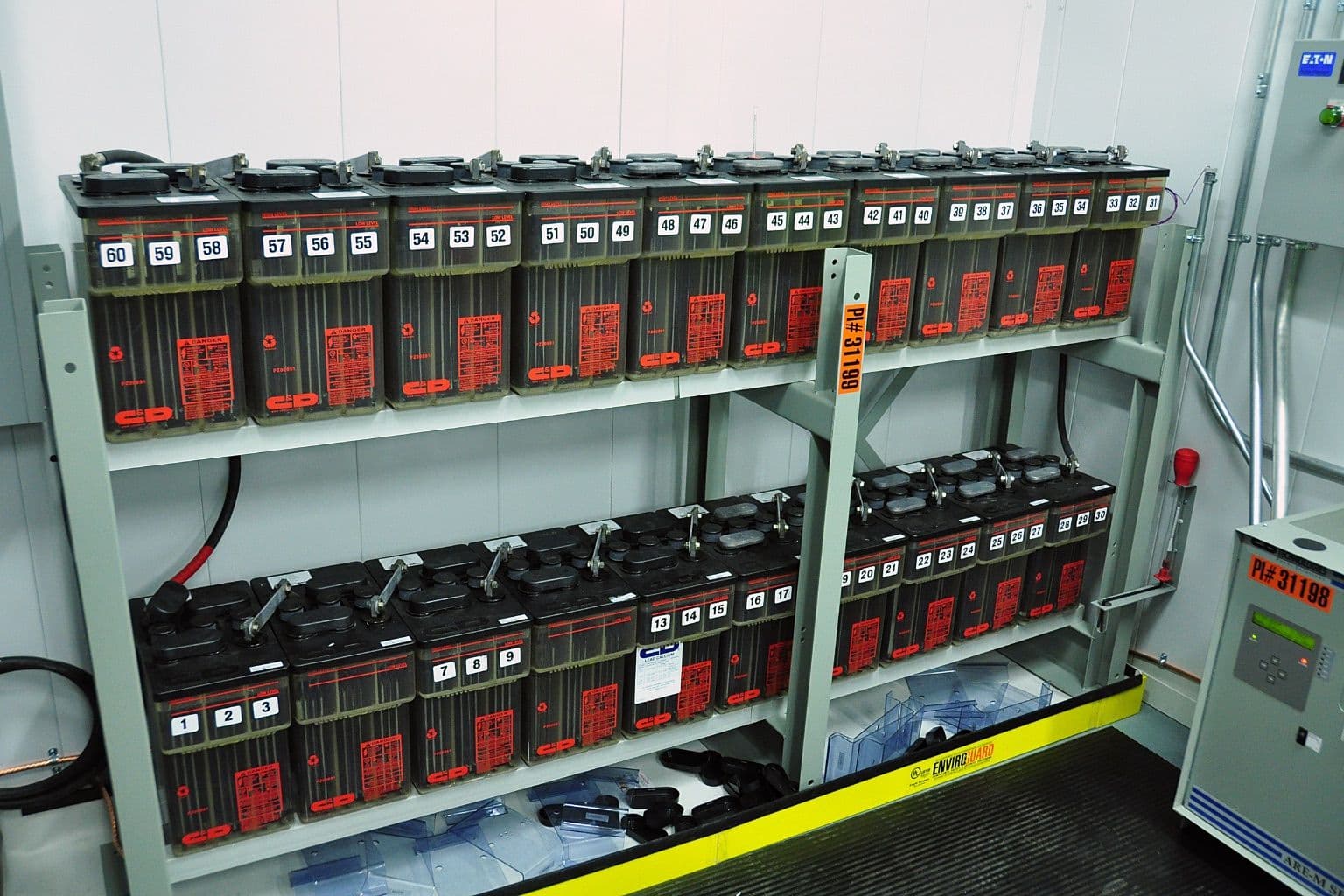
Cover photo: Telecomm batteries by Paul Chernikhowsky from Kelowna, BC, Canada, via Wikimedia Commons (CC BY 2.0).