RTX 3060 in Dubai: The 12 GB Trap and What a Business Should Buy Instead
An RTX 3060 attracts business buyers in Dubai for one reason: 12 GB of graphics memory on a 170 W card that runs from a 550 W power supply. The catch is that NVIDIA also lists an 8 GB RTX 3060 on a narrower memory interface, and the two are sold under the same name. Codeeo Tech does not list the RTX 3060, so this page explains how to buy one safely elsewhere and which professional cards on our shelf answer the same need.
That is an unusual way to open a supplier's article, and it is deliberate. Most searches for an RTX 3060 in the UAE come from someone with a specific job in mind, and the honest answer depends on what that job is.
What NVIDIA lists for the RTX 3060
NVIDIA's RTX 3060 family page, read on 14 October 2026, gives these figures for its reference design. NVIDIA notes that add-in-card makers can vary power and clocks.
| Specification | RTX 3060 | RTX 3060 Ti |
|---|---|---|
| CUDA cores | 3,584 | 4,864 |
| Boost clock | 1.78 GHz | 1.67 GHz |
| Memory | 12 GB or 8 GB GDDR6 | 8 GB GDDR6 or GDDR6X |
| Memory interface | 192-bit (12 GB) or 128-bit (8 GB) | 256-bit |
| Graphics card power | 170 W | 200 W |
| Required system power | 550 W | 600 W |
| Bus | PCI Express Gen 4 | PCI Express Gen 4 |
Note the odd result in the middle row. The cheaper RTX 3060 carries more memory than the faster RTX 3060 Ti, 12 GB against 8 GB, which is exactly why the 12 GB card became popular for rendering and local AI work where capacity matters more than speed.
The 12 GB and 8 GB trap
NVIDIA lists the RTX 3060 with 12 GB on a 192-bit interface and 8 GB on a 128-bit interface. The 8 GB card therefore loses a third of its memory and a third of its bus width at the same time, and a listing or quotation that says only "RTX 3060" does not tell you which one you are getting.
Check three places where the memory size can hide: a marketplace listing that puts it in small print, a used card sold in a box that may not match the board inside, and a prebuilt system whose specification sheet names the GPU but not its memory. Before you pay, ask for the full partner model number and check its memory size and interface on the board maker's own page. If the seller cannot give a model number, that is the answer.
Why 12 GB matters, in numbers
A 7 billion parameter AI model at 8 bits per weight needs about 7 GB for its weights. That fits on the 12 GB RTX 3060 with roughly 5 GB left for context and working memory, and it is a squeeze on the 8 GB card once the operating system and the application take their share. At 16 bits the same model needs about 14 GB and fits on neither. For a rendering seat the same logic applies to scene size: the card either holds the scene or hands the work back to the CPU.
Power and heat across a whole office
A single 170 W card is easy to ignore. Twenty of them in a Business Bay design office is a different calculation. Against a 70 W professional card, each RTX 3060 seat adds about 100 W at full load, so twenty seats add roughly 2,000 W of power draw, all of which the office air conditioning then has to remove as heat. That figure also lands on the UPS if the desks are protected, which is where our note on reading a UPS nameplate in watts rather than VA becomes relevant.
The 550 W system requirement is the second check. If the machine's supply is rated below that figure, an RTX 3060 upgrade includes a power supply replacement, and in a compact chassis the replacement may not fit at all. Read the label inside the machine before ordering, not the brochure.
Where a business should not use an RTX 3060
- In a server room or colocation rack. NVIDIA's driver licence, version dated 25 February 2025, says in section 2.8 that GeForce software is not licensed for datacenter deployment. A shared inference box built on GeForce cards in a Jebel Ali or Dubai Silicon Oasis data hall sits outside that licence.
- Where memory errors matter. The RTX 3060 has no error-correcting memory. Engineering, financial and scientific work that cannot tolerate a silent error belongs on a card that has it.
- Where you need a clear warranty. NVIDIA's GeForce warranty runs three years from the purchase of a new card and applies to original purchasers. A second-hand card in 2026 normally carries only what the seller promises in writing.
What to buy instead from a business supplier
The professional cards below sit in the same role as a 12 GB RTX 3060 on a business desk, and all of them are in Codeeo Tech's NVIDIA range. The figures are from NVIDIA's product pages, read on 14 October 2026.
- RTX 2000 Ada Generation: 16 GB of GDDR6 with error correction at a maximum of 70 W, in a 2.7 inch by 6.6 inch dual-slot card with four mini DisplayPort 1.4a outputs. That is 4 GB more than the RTX 3060 at well under half of its 170 W, which makes it the card for compact office workstations whose power supplies could never meet NVIDIA's 550 W requirement for the 3060.
- RTX A4000: 16 GB of GDDR6 with error correction at 140 W in a single slot. Still below the RTX 3060's power figure, with more memory, and thin enough for multi-GPU builds.
- RTX A2000: the smaller Ampere professional card, for CAD and multi-monitor desks rather than AI work. Confirm the memory variant on the quotation, as with any card sold in more than one size.
If the job needs more than 16 GB, the step up is a 24 GB card, and our notes on the RTX 3080 and the RTX 4080 compare those options against the power and chassis limits of a typical office machine.
If you still want an RTX 3060
For a home or gaming build it remains a reasonable card, and the checks are short.
- Get the full partner model number and confirm 12 GB on a 192-bit interface.
- Confirm the power supply meets NVIDIA's 550 W system requirement.
- Check the purchase date and who in the UAE accepts a warranty return, using the points in our guide to genuine versus grey market hardware.
For business desks, every Codeeo Tech item is priced through Add to Quote. Send the workstation model and the workload through the contact form and the reply can match it to one of the cards above.
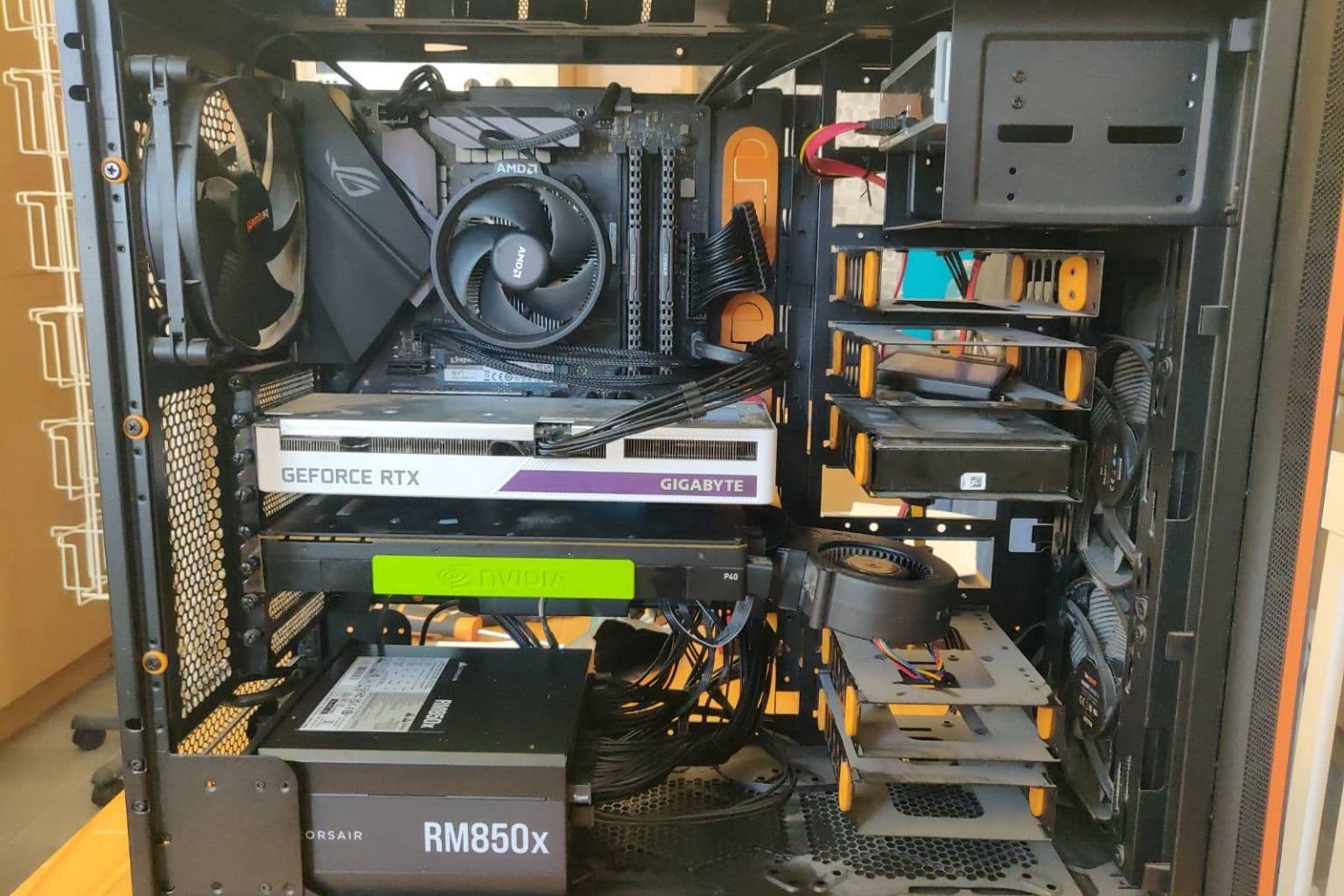
Cover photo: Be Quiet PC Case Interior with GTX 3060 and P40 by Tim Sheerman-Chase, via Wikimedia Commons (CC BY 4.0).