What Structured Cabling Certification Reports Actually Prove
A certification report proves one narrow thing: that on a stated date, each fixed cable run was measured against a named standard limit, with an instrument of a named accuracy class, and every parameter came in on the right side of that limit. It does not prove the contractor picked the correct limit, that the instrument was qualified for the category you paid for, or that the same link will still pass in August with the ceiling void at 45 degrees. Four things on the page tell you whether the handover is worth accepting: the test limit, the accuracy level, the margins, and the asterisks.
Most UAE fit-out handovers arrive as a single PDF with a green PASS column and 300 rows. That document is easy to produce and easy to fake confidence with. The detail below is what an infrastructure engineer reads first, and what a buyer can ask for without needing a tester in hand.
Permanent link or channel, because the limit is not the same
Fluke Networks sets out the two link models plainly. The channel is the connection from one active device to another, patch cords and equipment cords included, and it runs to a maximum of 100 metres. The permanent link is the fixed portion that does not change, it runs to a maximum of 90 metres, and it is what contractors normally certify because it tests the infrastructure they actually installed.
The channel limit is the looser of the two, since it allows for cords the standard assumes will be replaced. A permanent link measured against a channel limit can therefore show a comfortable PASS while sitting outside the limit it should have been held to. Open the report header and read the limit name. If you bought Category 6A permanent links, the header should say a Category 6A or Class EA permanent link limit, and it should say the same thing on all 300 rows.
One more model appears in newer reports. ANSI/TIA-568.2-D added the Modular Plug Terminated Link, where the horizontal cable ends in a plug that goes straight into a device, used where an outlet and equipment cord are impractical, typically security cameras and LED lighting. Fluke Networks specifies testing it with a permanent link adapter at one end and a patch cord adapter at the other. If your camera runs are certified as ordinary permanent links, the final plug was never in the measurement.
The accuracy level decides whether the instrument was allowed to judge
ANSI/TIA-1152-A, published in November 2016, sets the accuracy performance requirements for field testers and defines the levels you will see printed on a report: Level IIe for cabling up to Category 5e, Level III up to Category 6, Level IIIe up to Category 6A, and Level 2G for Category 8. Fluke Networks states that Level IIIe to IEC 61935-1 and ANSI/TIA-1152 supports testing Class EA and Category 6A to 500 MHz. The IEC counterpart adds Level IV for Class F to 600 MHz and Level V for Class FA to 1 GHz.
This is the fastest check on the whole document. A Category 6A installation certified by a Level III instrument was measured by a device the standard does not qualify for 500 MHz work. Ask for the tester model, its accuracy level, the calibration date, and the adapter type. Permanent link adapters wear out, which is why serious testers count adapter insertions, and why a report from an adapter near the end of its rated life deserves a spot check.
Asterisks are the most useful column on the page
A parameter is marked with an asterisk when the result is closer to the test limit than the measurement accuracy the tester manufacturer publishes. Fluke Networks notes that the marking is required by ANSI/TIA-1152 and IEC 61935-1, and that TIA and ISO/IEC treat a marginal pass as a pass, so PASS* is compliant. The width of that marginal band changes with frequency, so two links with the same margin can be reported differently.
Compliant is not the same as well built. If 12 links out of 300 come back PASS* on NEXT, that is a workmanship pattern worth a conversation, usually a single installer untwisting pairs too far back at the jack. Ask for the summary sorted by worst margin rather than by link ID. The alphabetical sort is what hides the eight runs that scraped through.
What each parameter is really reporting
Wire map catches crossed pairs, shorts and split pairs, which is termination work. Insertion loss is governed by length, conductor quality and temperature. NEXT and PSNEXT degrade when pair twist is opened up at the connector, which is the single most common cause of a marginal Category 6A result. Return loss punishes kinks, over-tightened cable ties, staples and bend radius violations, because each one is an impedance step the signal reflects off.
Two parameters matter more than they used to. ANSI/TIA-568.2-D limits DC resistance unbalance within a pair to 3 percent of that pair's total loop resistance or 0.20 ohms, and between pairs to 7 percent or 0.20 ohms. Fluke Networks explains why: Power over Ethernet is carried as a common mode voltage split across conductors, and unbalance can saturate a device transformer, producing distorted data, bit errors, retransmits and links that simply do not come up. The listed causes are bend radius violations, untwisting at terminations, poor terminations, and non-compliant cable using copper clad aluminium instead of solid copper, which is exactly the failure mode that makes cable provenance worth checking before the first reel is pulled.
The temperature your report was not measured at
Copper gets lossier as it warms, and the standards correct for it against a 20 degree reference. ISO/IEC 11801:2011 derates by 0.2 percent per degree for screened cable, and for unscreened cable by 0.4 percent per degree from 20 to 40 degrees and 0.6 percent per degree above 40 degrees. ANSI/TIA-568-C.2 turns that into a length table: at 40 degrees the maximum horizontal run falls to 84.0 metres unscreened and 87.0 metres screened, and at 50 degrees to 79.5 metres and 85.5 metres.
Now put that in a Business Bay or JLT ceiling void in August, above a floor where the chillers run to a building schedule and the void sits well above the occupied space. A report signed in February at 22 degrees says nothing about that. If the longest links on your floor plan are 87 or 88 metres, the design has already spent the temperature allowance. The practical rule for Dubai fit-outs is to cap horizontal runs at about 80 metres in hot voids, or to specify screened cable where the route has no realistic alternative, a decision that belongs in the cabling specification rather than in a variation order later.
Power over Ethernet heats the bundle, not the room
TSB-184-A, published in March 2017, is the TIA guidance for cabling that carries remote power. It recommends Category 6A or better four pair balanced twisted pair cabling for new installations delivering power, supports delivery on all four pairs at up to 1000 mA per pair for 100 watts, and recommends limiting bundles to 24 cables to hold down temperature rise, with unbundled routing preferred where the tray allows it.
That matters because the cable in the middle of a 60 cable bundle feeding ceiling access points and cameras is not at room temperature. Certification is done with no power on the link, so the report is a cold measurement of a link that will spend its life warm. Insertion loss margin in decibels, per link, is the number that tells you whether there is room for that.
What to ask for before you sign the handover
- The native test database from the instrument, not only an exported PDF, so results can be reopened and re-sorted.
- The test limit named on every record, and a reason in writing if any record uses a different one.
- Tester model, accuracy level, serial number, calibration date and adapter type.
- A list sorted by worst margin, with every PASS* result shown separately.
- Link IDs that match the physical labels and the floor plan, so a fault in year three can be traced to a row.
- The test date per link, and a flag on anything retested after a repair.
None of that costs the contractor anything if the work was done properly. Refusal to supply it is itself information.
Matching the active hardware to what the cabling can carry
Certified Category 6A permanent links only pay off if the switch at the other end can use them, which means multigigabit ports where Wi-Fi 7 access points are going in, and PoE budget calculated for the real load rather than the port count. Codeeo Tech supplies switching, access points and cabling-adjacent hardware from Cisco and D-Link among others, and every item is quoted rather than priced online. Send the certified link lengths, the worst insertion loss margins and the PoE device count with your enquiry, and the quotation can be built against the cabling you actually have.
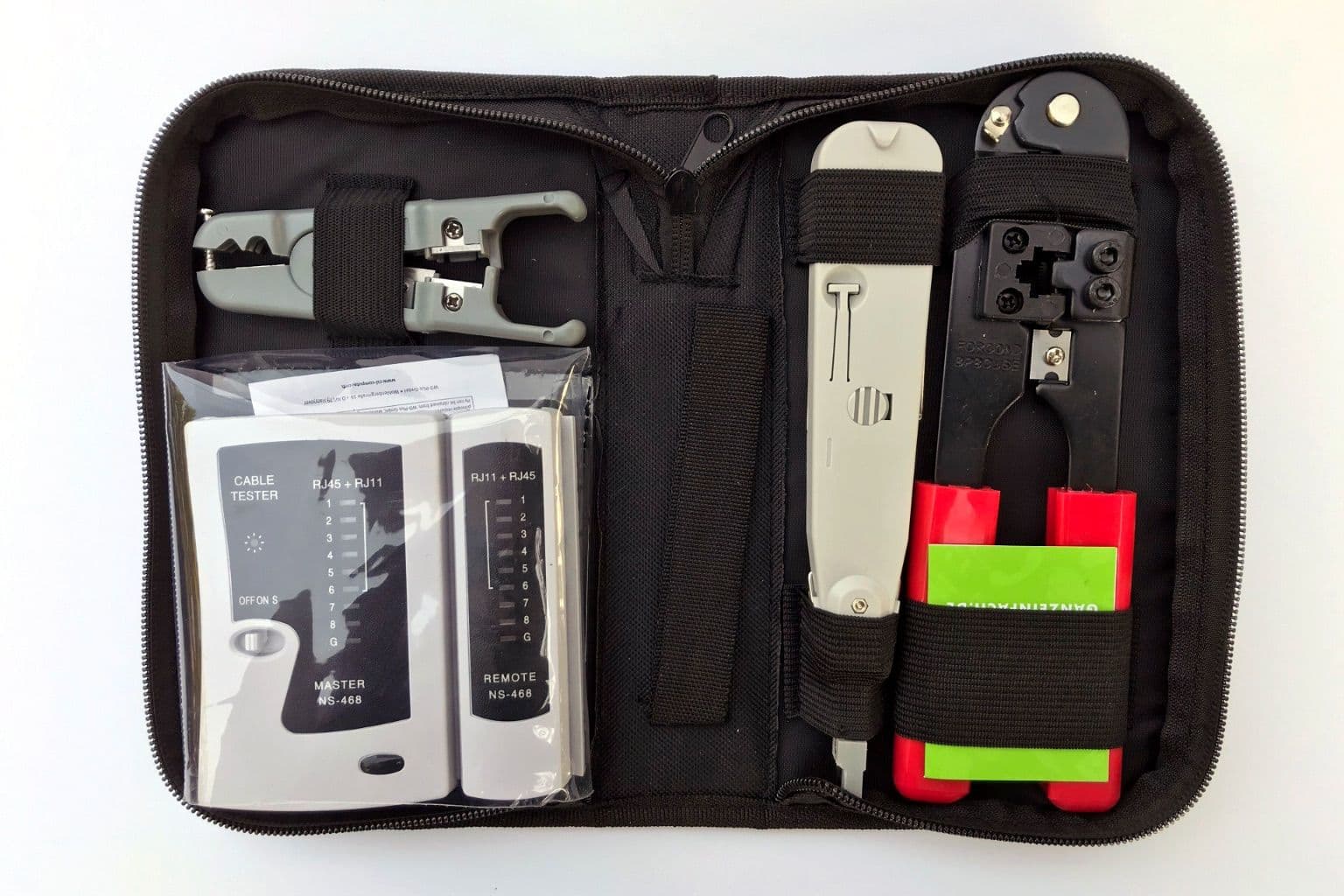
Cover photo: Cable stripper, cable tester (RJ45, RJ11), LSA-Tool and crimping tool by www.heimnetzwerke.net, via Wikimedia Commons (CC BY 4.0).