Cisco Smart Licensing: The Licence Does Not Come With the Box
A second-hand Catalyst will power up, pass traffic and give you a login prompt. None of that settles the licence for the software running on it. Cisco's relicensing programme page defines secondary-market equipment as any Cisco equipment, represented as new, used or refurbished, bought from a seller that is not an authorised Cisco reseller or distributor, and states that Cisco software, whether embedded operating system or standalone application, is not transferable unless the Cisco Software License Transfer and Re-Use Policy specifically allows it.
Hardware and software move separately. The chassis changes hands at the loading bay in Jebel Ali. The right to run the code on it does not travel with the pallet, and nothing in the boot sequence will stop you to say so.
Smart Licensing Using Policy removed the step that used to fail loudly
Cisco introduced Smart Licensing Using Policy in Cisco IOS XE 17.3.2 and 17.4.1 for Catalyst switching platforms, and it is enabled by default on factory-shipped devices. The headline change, in Cisco's own words in its Catalyst switching licensing document last updated on 1 June 2026, is that with Smart Licensing Using Policy you do not have to register the product to Cisco License Central. The same document notes that evaluation mode, registration and reservation go away under this model.
That is a sensible change for a legitimate owner and a trap for everyone else. Under the older model there was a registration step that could fail in front of you. Remove it and a device bought from an unknown source behaves exactly like one bought properly, right up until the day somebody needs support on it. The absence of an error message is not evidence of a licence.
The device still reports, into somebody's account
Under Smart Licensing Using Policy the product instance generates Resource Utilization Measurement reports, which Cisco documents as usage reports following the ISO 19770-4 standard. The default reporting interval is 30 days. The reports record what the device consumed, and they flow to Cisco through a trust code taken from Cisco License Central on the Virtual Account General page, installed with the command license smart trust idtoken.
Read that carefully if you are buying used. The trust code belongs to a Smart Account and a Virtual Account, and those belong to whoever set the device up. The entitlement is an entry in an account you have no access to, not a property of the metal in your rack. Ask the seller which Virtual Account the unit last reported into, and watch what happens to the conversation.
What Cisco requires before the software is yours to run
The relicensing programme page is direct about the consequences. It states that used and secondary-market equipment is not covered under the Cisco standard warranty, and that you cannot place it under a Cisco service and support contract unless it is relicensed by Cisco and has passed Cisco's inspection. It also states that for the software licences purchased, you must register the licence with the serial number of the Cisco hardware for which the licence has been purchased.
So the fix exists, and it has two parts: an inspection of the hardware and a new licence bought against that specific serial. This is a different question from the support entitlement chain, which turns on who Cisco authorised to sell you the box. The Approved Source chain behind a Cisco purchase in Dubai covers that side. A unit can fail both tests at once, and buyers routinely discover them one at a time.
The inspection clock runs longer here
Cisco's Hardware Inspection and Software Relicensing Program page states that Cisco will schedule an inspection at your site within 5 business days in the United States and Canada, and 10 business days in the rest of the world. The UAE sits in the rest of the world. Two working weeks can pass before an inspector is even booked, and that is the scheduling window rather than the completion of the relicensing.
Cisco also lists exceptions where a new licence fee is not required, including transfers to an affiliate, transfers arising from a merger, acquisition or divestiture, financed software, and transfers within Europe. A Dubai company buying surplus switches from a trading firm in Deira meets none of those conditions. Check the exception list before assuming you are inside it, because the four that exist are narrow and specific.
Where this surfaces in a real project
The failure is almost never at installation. A fit-out in Business Bay takes delivery, the switches stack, the VLANs come up over the cutover weekend and the project closes. The licence question appears months later: a feature needs enabling, a TAC case gets raised, or the finance team asks why a support renewal quote came back refused. By then the switches are carrying production traffic and the cheap purchase has become a cutover you have to schedule twice.
That timing is what makes licensing different from the usual grey-market argument. A counterfeit transceiver fails fast and visibly. A licensing gap is silent, survives the handover, and only presents a bill when you need Cisco to do something for you. The broader question of genuine against grey market hardware in the UAE is worth reading alongside this, as is the reality that refurbished enterprise hardware can be a sound buy when the paperwork is handled rather than skipped.
Questions worth asking before the purchase order
Five questions separate a supplier who has thought about this from one who has not:
- Which Smart Account and Virtual Account has this product instance been reporting into, and will it be released?
- Is the software licence being sold with the hardware, and under what Cisco policy is that transfer permitted?
- Has the unit been through Cisco's inspection and relicensing, and can you show the outcome?
- What IOS XE version is on it now, given that Smart Licensing Using Policy starts at 17.3.2?
- If Cisco declines to relicense, what happens to the order?
That last one is the question that matters, because it moves the risk. A supplier willing to answer it in writing is telling you they expect the relicensing to succeed. A supplier who will not is telling you where the risk is meant to land. Verifying the supplier itself is a separate exercise, and the designations changed recently enough that the old Gold Partner language in your tender template may no longer mean anything.
Buying with the licence settled first
None of this makes used Cisco a bad purchase. It makes the licence a line item rather than an assumption. Price the relicensing and the inspection window into the comparison at the start, and a second-hand switch either still wins or stops looking cheap, which is the answer you wanted either way.
Codeeo Tech supplies Cisco alongside HPE, Dell EMC, Juniper and Supermicro from Building A1, IFZA Business Park in Dubai Silicon Oasis. You can browse the Cisco range or send part numbers and your licensing requirement through the contact form, and the reply will address the licence position alongside the specification.
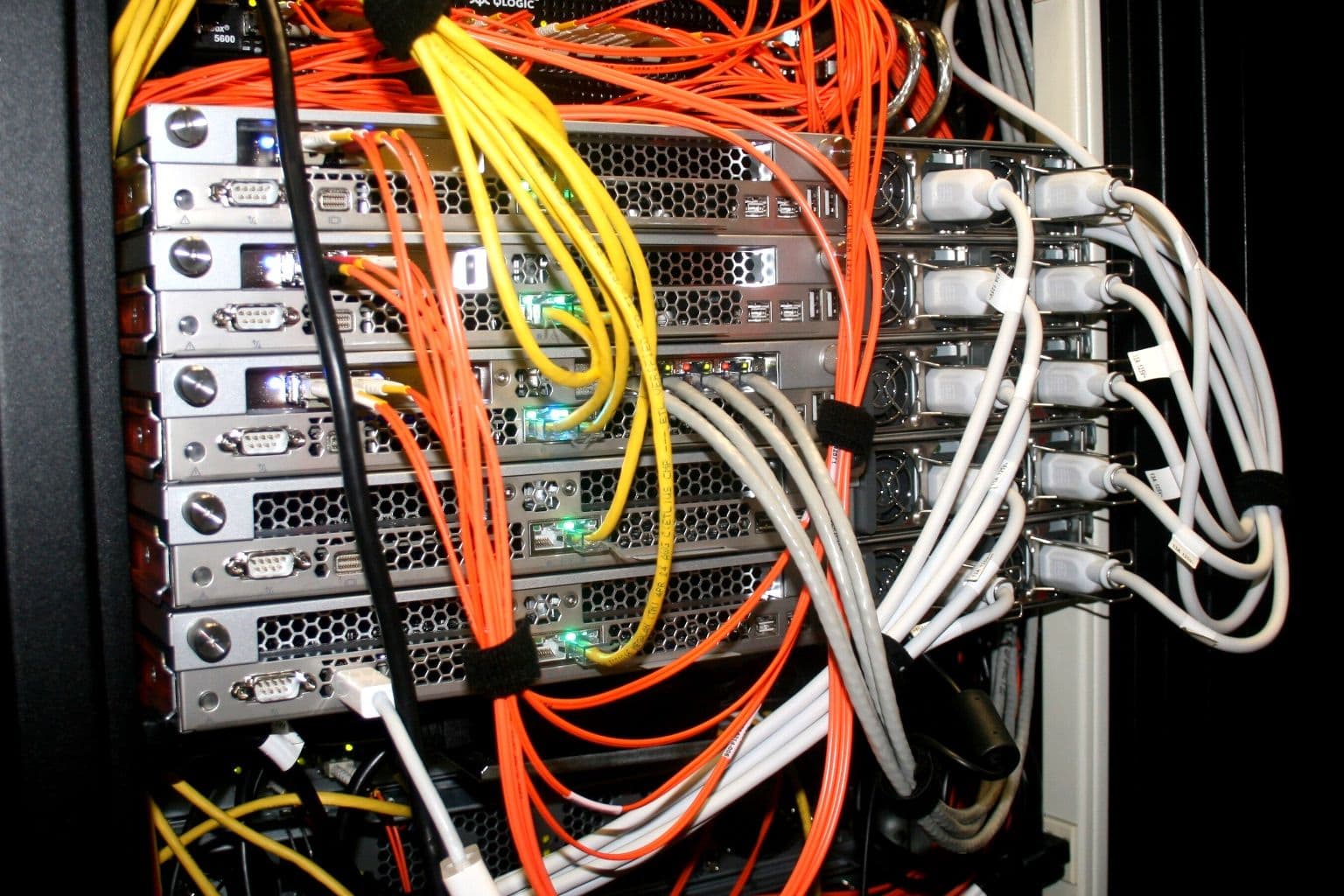
Cover photo: Final Cut Server installed, rear view, by NASA Goddard Photo and Video, via Wikimedia Commons (public domain).