UPS Battery Replacement Cycles in UAE Conditions
The three to five year figure you were quoted for a UPS battery assumes a room held at 20 to 25 degrees Celsius, and most comms rooms in the UAE are not that room. Schneider Electric's own guidance is that every 8 degree rise above that band halves battery life, so a string rated for five years in a cooled data hall is closer to two and a half in a cupboard sitting at 33 degrees through August. Plan the replacement against a measured room temperature and a capacity test, not the datasheet.
Where the published life figures actually come from
Schneider Electric's FAQ FA158934, last modified on 17 February 2026, states that most APC batteries should last three to five years, that the optimal range is 20 to 25 degrees Celsius, and that every 8 degree increase halves battery life. It lists what else shortens it: repeated deep discharge cycles, frequent runtime calibrations, loads above 80 percent of rated capacity, storage without recharging, and poor ventilation.
Schneider's FAQ000265093, last modified on 19 June 2026, puts the battery in context against the rest of the machine: VRLA three to five years, lithium ion eight to ten, the chassis and electronics seven to ten, and electrolytic capacitors and fans an estimated ten. It also sets a decision rule worth writing down. Once a UPS is more than eight years old and the battery has reached end of life, buy a new unit rather than another battery.
Vertiv's service eBook on battery maintenance is blunter about the gap between design life and reality. Its field testing found batteries losing capacity in as little as three years, with a ten year design life undone by incoming power faults, high room temperatures, high or low charge voltage, excessive charge current, overcharging, loose connections and strained terminals. Every item on that list except manufacturing defects is one you control on site.
The weekly self test does not measure what you think it measures
Schneider's FAQ000267818, last modified on 3 September 2026, describes the Back-UPS self test plainly: the unit forces itself onto battery for approximately 10 seconds, calculates runtime, and raises a replace battery alarm if that runtime falls close to or below the standard two minute limit. It runs every seven days, and again on every power cycle.
Ten seconds is a gross failure check. It confirms the battery still delivers current. It does not tell you that the string which once gave eighteen minutes now gives six, and six minutes is the difference between a scripted shutdown and a hard stop on a virtualisation host. A UPS that has passed its self test every Friday for two years can still hold a battery that will not carry the load to the end of a DEWA interruption.
When the red replace battery LED does light, treat it as a deadline. Schneider's FA158816, last modified on 1 April 2026, says the battery needs replacing within four weeks. Before ordering, charge the unit fully, a minimum of eight hours for a standard UPS and 24 hours with external battery packs attached, then run the self test again. If the LED stays lit, the diagnosis holds.
The deeper test is a runtime calibration, which discharges the unit properly. Use it sparingly: FA158934 lists frequent calibrations among the things that shorten battery life and recommends only one or two a year.
The measurement that decides the replacement is capacity
The standards work in capacity, not calendar years. IEEE 1188 covers valve regulated lead acid, which is what sits inside almost every UPS in a UAE office, while IEEE 450 covers vented lead acid and IEEE 1106 nickel cadmium. The current edition, IEEE 1188-2025, was board approved on 10 December 2025.
Both standards set the same threshold: replace the battery once capacity falls below 80 percent of the manufacturer's rating, and take no longer than one year to do it. The earlier warning line, per Vertiv's summary of the same guidance, is a drop of more than 10 percent from the previous capacity test or a reading below 90 percent of rating. The 80 percent point matters because ageing accelerates past it, so a string that has just crossed it will not coast through another summer.
On frequency, the recommended practice is a capacity test at installation, periodic tests at intervals no greater than 25 percent of expected service life, and annual tests once the battery degrades or reaches 85 percent of that life. Those are percentages, so the schedule moves with the room. That is the part most UAE sites get wrong.
Working the percentages against a real room temperature
Apply the APC halving rule to the five year end of the range, then apply the IEEE intervals to the result. The arithmetic below is derived rather than quoted, but both inputs are the published figures above.
| Sustained room temperature | Realistic VRLA service life | Capacity test every (25 percent of life) | Annual testing starts at (85 percent of life) |
|---|---|---|---|
| 25 C, properly cooled room | 60 months | 15 months | 51 months |
| 33 C, cupboard on tenant cooling | 30 months | 7 months | 26 months |
| 41 C, riser with no cooling at all | 15 months | 4 months | 13 months |
The middle row is the common case in a Business Bay or JLT tower, where the comms cupboard runs on tenant supplied cooling rather than the landlord's chilled water and that cooling is the first thing switched off during a fit out. A thirty month replacement cycle with a capacity test every seven months is a position you can defend in front of a finance director. A five year cycle in the same cupboard is a promise you cannot keep.
This is also the arithmetic that makes lithium ion worth pricing in the UAE. Schneider's FAQ000265882, last modified on 6 October 2025, puts APC lithium ion service life above ten years against three to six for VRLA, and notes that lithium ion is less affected by high temperatures, with many UPS lithium packs designed for average temperatures around 40 degrees Celsius. In a room you cannot cool reliably, that chemistry removes two or three replacement events from the ownership period.
Symptoms that mean replace now rather than at the next review
A bulged case, acid residue around a vent, or a monobloc noticeably hotter than its neighbours is not a scheduling problem. Vertiv names abnormally high cell temperatures and physical plate condition as replacement indicators in their own right, ahead of any capacity figure. Move the load and replace the string.
Loose or strained terminals sit on the same failure list and deserve a torque check at every visit. In a room that swings from 24 degrees under cooling to 38 when the air handling stops for a weekend, the metalwork moves, and a connection that was correct at handover is not automatically correct eighteen months later.
Buying the replacement without inheriting an old battery
Ask for the date of manufacture on the cells, and treat it as a specification line rather than a courtesy. FA158934 sets storage recharge intervals by temperature: every six months between minus 15 and plus 30 degrees Celsius, and every three months once storage sits between 30 and 45 degrees. A pack that spent a UAE summer in an uncooled warehouse without a top up charge has already used part of the life you are about to pay for.
Have five things ready before you send the enquiry: the UPS model and serial from the nameplate, the battery part number or cartridge reference, the number of strings in the system, the date code on the batteries coming out, and the measured load in watts. That last figure decides something the part number cannot, because a unit that has been running at 95 percent load has been cooking its own battery, and reading it correctly is covered in VA or watts, reading a UPS nameplate properly. If the UPS is past the eight year mark, price a replacement unit alongside the battery and size it using the sizing and runtime method for Dubai offices, and check lead times and stock reality for enterprise hardware in the UAE before you commit to a cutover date.
Disposal is a regulated step, not an afterthought
Used lead acid batteries are hazardous waste in the UAE. Federal Law No. (12) of 2018 on Integrated Waste Management, issued on 18 December 2018, and its executive regulations under Cabinet Resolution No. (39) of 2021 govern the handling, and moving hazardous waste within the country requires written permission from the Ministry of Climate Change and Environment under the Basel Convention.
Dubai has an instrument written for this exact material. Dubai Municipality Circular No. (3) of 2018 covers the transport, recycling and disposal of used lead acid batteries, and Technical Guideline No. 11 covers the transportation and handling of hazardous waste in the emirate. The old string leaves the building with a permitted contractor and a paper trail, not in the back of a technician's car. Do not park the removed batteries in the comms room while you arrange that, because a warm room and exposed terminals is the wrong place to store what you have just condemned.
What to record so the next cycle is a decision, not a surprise
Six fields against each UPS will do it: installation date of the current string, battery part number, date code on the cells, the temperature the room actually runs at, the result and date of the last capacity test, and the calculated replacement date from the table above. Keep them where the rest of the estate lives rather than in one person's inbox, as argued in a practical asset register for a UAE SME.
Codeeo Tech supplies APC across the Smart-UPS, Smart-UPS On-Line, Easy UPS On-Line and Symmetra ranges together with the matching battery systems, and the current listings sit under APC on the store. Every line is quoted rather than priced online, so send the model, serial, string count and measured watt load and the quotation comes back against your installation rather than a part number guess.
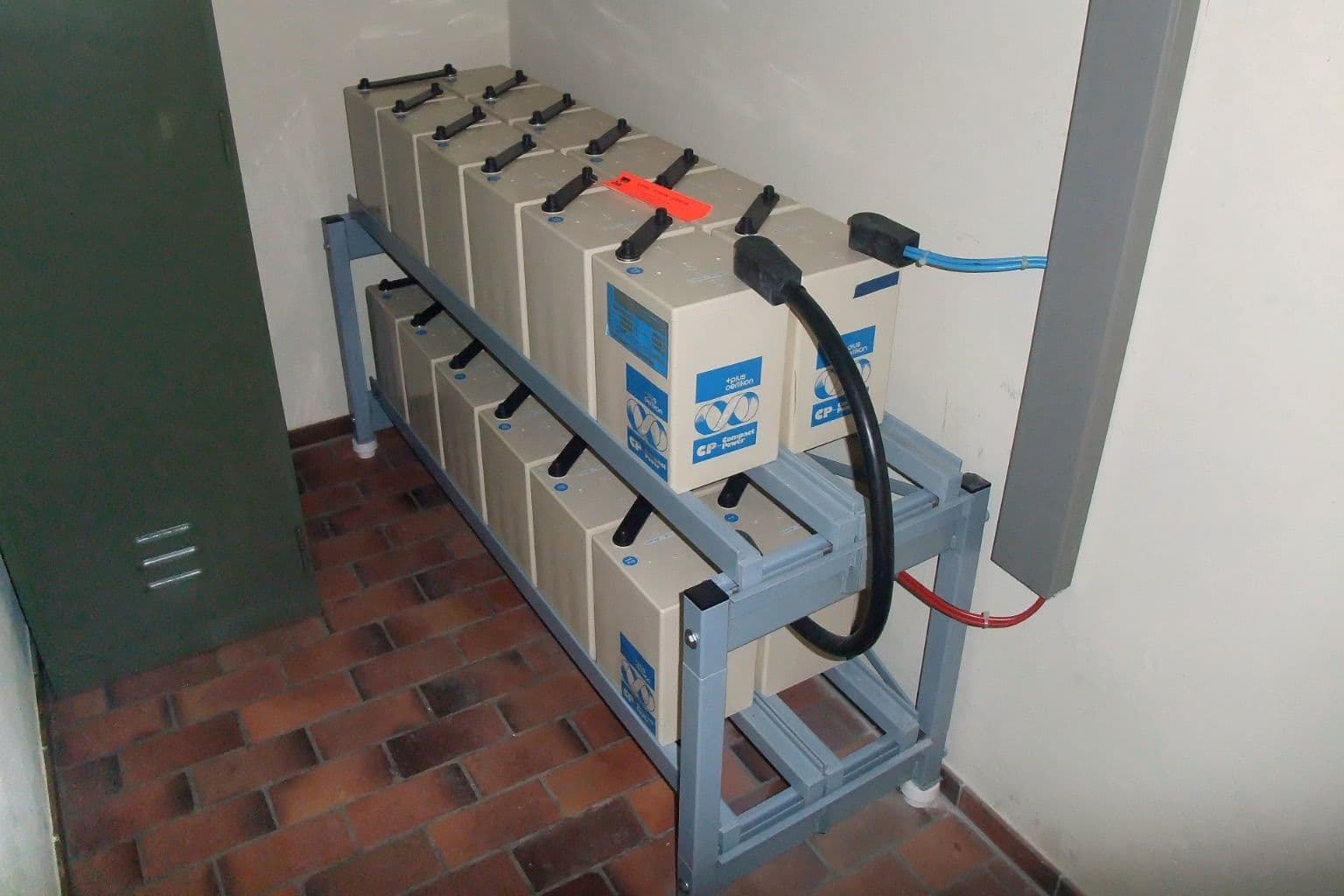
Cover photo: Fort «Furggels» - Battery Power Supply (5166616214) by Kecko from Switzerland (Rheintal SG, the border valley between Switzerland and Austria), via Wikimedia Commons (CC BY 2.0).