Lenovo ThinkSystem DM5000H: What the Spec Sheet Does Not Make Obvious
The Lenovo ThinkSystem DM5000H is a 2U unified hybrid storage array running ONTAP, with two controllers, 64 GB of RAM across the pair, 8 GB of battery-backed NVRAM, 2 TB of NVMe Flash Cache and 24 small form factor drive bays. It speaks NFS and SMB for file access and iSCSI and Fibre Channel for block, which is why one box can replace a file server and a SAN at the same time.
That much is on the first page of Lenovo's product guide. The parts that decide whether the purchase goes well are further in, and three of them routinely catch buyers out: the warranty hides in the machine type, the capacity ceiling is quoted twice with two different numbers, and encryption is settled when you place the order rather than afterwards.
What the hardware actually is
Each controller carries 32 GB of RAM, 4 GB of NVRAM mirrored to its partner, and 1 TB of NVMe Flash Cache. Host connectivity comes as eight base ports per enclosure, four per controller, configured either as 1 GbE or 10 GbE and 4/8/16 Gb Fibre Channel SFP+, or as eight 1/10 GbE RJ-45 copper ports. The HA pair talks to itself over four 10 GbE SFP+ interconnect ports. Lenovo rates the system at up to 148,000 random read IOPS on 8 KB blocks.
Expansion runs over 12 Gb SAS. A single array reaches 144 SFF bays using the controller enclosure plus five DM240S 2U24 shelves, or 24 SFF plus 120 LFF bays using two DM600S 4U60 shelves. Drive choices are 960 GB to 15.36 TB SAS SSDs, 900 GB to 1.8 TB 10K SAS HDDs, and 4 TB to 16 TB 7.2K NL SAS HDDs in the LFF shelves. RAID options are RAID-4, RAID-DP and RAID-TEC, and if the difference between those and a backup is not settled in your head, settle it before you buy.
The warranty is in the first four characters
Lenovo does not sell the DM5000H warranty as a line item you can read on a quotation. It is encoded in the machine type, and two machines that look identical in a specification table can ship with one year or three years of cover.
| System | 1 year warranty | 3 year warranty |
|---|---|---|
| DM5000H controller enclosure | 7Y57 | 7D7V |
| DM120S 2U12 LFF expansion | 7Y59 | 7D7X |
| DM240S 2U24 SFF expansion | 7Y58 | 7D7Y |
The consequence reaches past hardware cover. Lenovo's guide states that software support is included in the Foundation or Essential service for the duration of the warranty period, which means a 7Y57 machine stops receiving ONTAP software maintenance after twelve months unless the warranty is extended. Two quotations for the same configuration can therefore differ by two years of software entitlement, and nothing on the page says so. This is the sort of line that is worth reading one item at a time.
Service level is a separate choice again. Foundation gives 9x5 coverage with next business day onsite response. Essential gives 24x7 coverage with a four hour onsite response. Premier Support sits above both. For a Dubai business, the question worth asking the supplier is not whether four hour response is offered but where the parts and the engineer actually are, because a four hour clock means something different in Jebel Ali at 02:00 than it does in a European capital.
Two capacity ceilings that do not agree
The product guide gives storage capacity as up to 1.917 PB, built from 120 LFF drives of 16 TB plus 24 SFF drives of 1.8 TB. A few lines below, under configuration maximums, it gives maximum raw storage capacity as 1.24 PB. Both numbers are correct and they measure different things. The first is what the drive bays physically hold. The second is what ONTAP will let you present. Plan against 1.24 PB.
The software edition moves the ceiling again. ONTAP Fundamentals supports up to 84 drives and does not support clustering at all, against 144 drives and clustering on the fuller licence. Up to 12 DM5000H arrays can be joined into one NAS cluster, or up to 6 into one SAN cluster, but only if the licence allows it. A business that buys Fundamentals to save money and plans to cluster later has bought a different product from the one it was imagining.
Other ONTAP limits are worth checking against your actual workload rather than assuming headroom: 400 TB maximum aggregate size, 1,000 FlexVol volumes per controller, 8,192 LUNs per controller, and a 100 TB maximum volume size that rises to 300 TB on ONTAP 9.12.1P2 and later. Maximum LUN size follows the same pattern, 16 TB rising to 128 TB on that release. If a single large volume is the reason you are buying the array, confirm the ONTAP version in the quotation.
Encryption is decided when you order
Lenovo ships the DM5000H with either an encryption or a non-encryption build of ONTAP, and the two are separate feature codes. The current guide lists ONTAP 9.17 Software Encryption and ONTAP 9.17 Software NonEncryption, and the same pairing for ONTAP 9.18. Published model part numbers carry the same split, marked NVE or Non-NVE.
Software based encryption of data at rest requires the encryption capable version, so this is not a licence you add on a Tuesday afternoon once a client contract asks for it. Any UAE firm with a data protection obligation written into its agreements, and in particular anything licensed in the DIFC, should decide this before the purchase order rather than after the array is racked and full.
What it does to a comms room in Dubai
The controller enclosure takes two redundant hot-swap 913 W power supplies on 100 to 240 V, and Lenovo publishes its heat output as 1,733 BTU per hour, which is about 0.51 kW. The shelves add their own: 1,331 BTU per hour for a DM240S 2U24, 1,153 for a DM120S 2U12, and 5,258 for a DM600S 4U60.
Do the arithmetic for the configuration you are actually buying. A controller enclosure with two DM600S shelves, which is the route to the 120 LFF bays, reaches 12,249 BTU per hour, or roughly 3.6 kW of heat into the room. That is a cooling conversation, not a rounding error, and in a Dubai summer it is the difference between a room that holds temperature and one that does not. The usual housekeeping rules apply with more force at that load.
Check the host list before you sign
The host operating system table in Lenovo's product guide, as published on 7 August 2026, lists Microsoft Windows Server 2012 R2, 2016 and 2019, Red Hat Enterprise Linux 6, 7 and 8, SUSE Linux Enterprise Server 11, 12 and 15, and VMware vSphere 6.0, 6.5, 6.7 and 7.0. Read that list against your own estate before you commit.
vSphere 7.x reached end of general support on 2 October 2025, after Broadcom extended the original date of 2 April 2025 by six months, so a 2026 buyer is very likely running vSphere 8 and will not find it in that table. The practical step is to confirm your hypervisor and operating system versions against Lenovo's live interoperability matrix rather than against the guide, and to get that confirmation in writing alongside the quotation.
What to send when you ask for a quote
Five things make the difference between a quotation you can compare and one you cannot. State the usable capacity you need and the mix of SSD and HDD behind it. State whether you need clustering, which decides the ONTAP edition. State encryption or no encryption. State the protocols, because FC and 10 GbE copper are different base port builds. State the service level and the warranty term you expect, then check the machine type on the quotation matches it.
If you are still deciding between an array like this and something simpler, the difference between direct attached storage, NAS and SAN is the place to start, since a DM5000H is a large answer to a question some offices do not have. Codeeo Tech carries Lenovo alongside Cisco, HPE, Dell EMC and Supermicro from Building A1, IFZA Business Park in Dubai Silicon Oasis. Browse the Lenovo range or send the five points above through the contact form and the quote will come back against that specification.
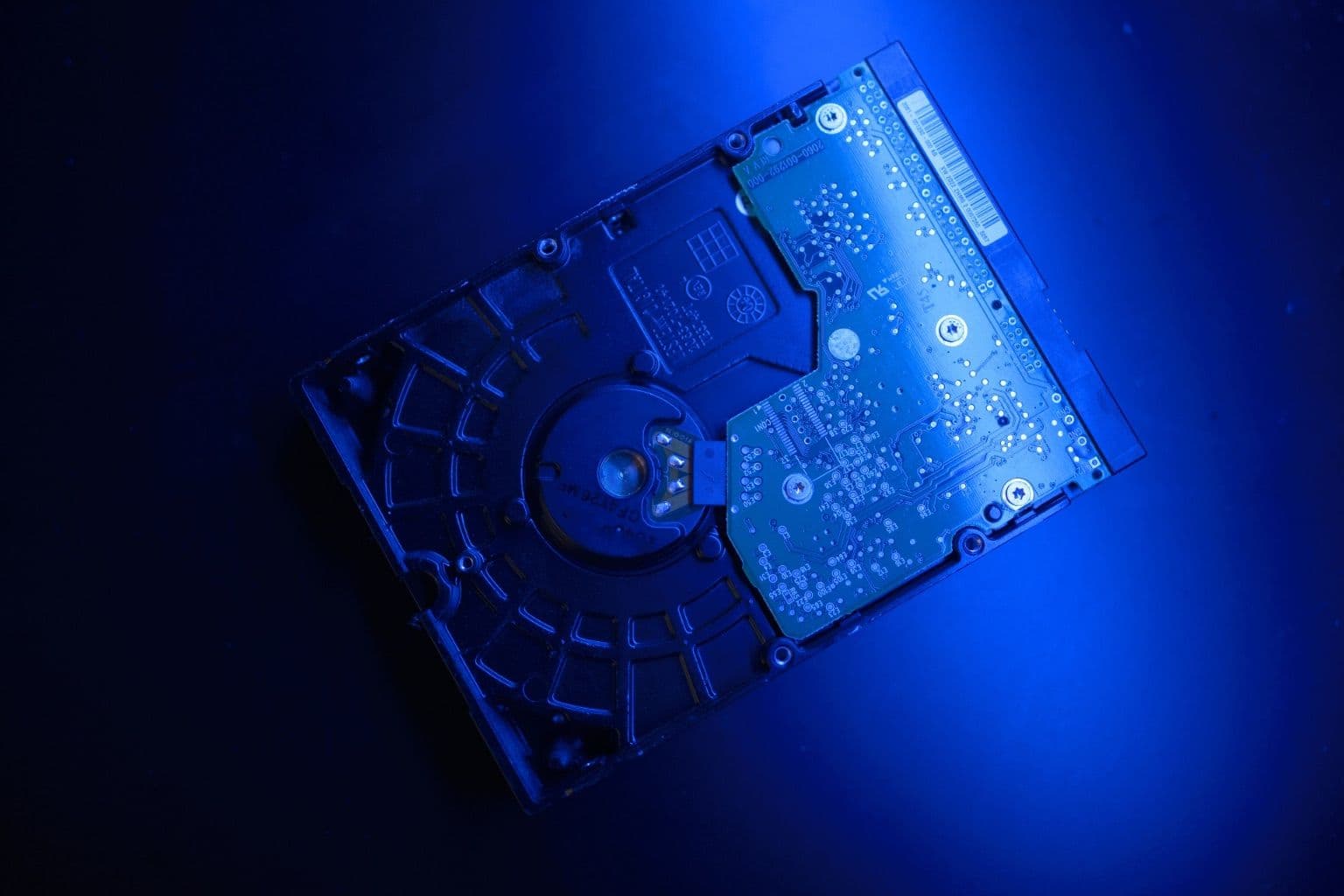
Cover photo: Computer hard disk drives with blue neon light from above by Shixart1985, via Wikimedia Commons (CC BY 2.0).