Server Storage for UAE Businesses: Direct Attached, NAS or SAN
If one server needs the capacity, put the disks in that server. If staff need the same documents from their laptops, buy a NAS and share files over SMB or NFS. If two or more servers need to run databases or hold virtual machines on one pool of disks, you need block storage over a network, which is a SAN. Most UAE purchases are settled by those three sentences. The rest is switch configuration, cable counts and settings you cannot change once the array is live.
The hardware figures below come from the Dell PowerVault ME5 Series Specification Sheet (copyright 2022), the ME5 Deployment Guide, the ME5 Support Matrix system rules page and Dell white paper H19551, "Dell PowerVault ME5 Storage System Best Practices", March 2023, all read on 1 October 2026. Protocols come from RFC 7143 (April 2014) and RFC 8881 (August 2020), and the Windows changes from Microsoft's "SMB security hardening in Windows Server and Windows Client" page, updated 15 September 2025. Where a number is our own arithmetic, we say so.
What actually separates the three
The split is block against file. A SAN hands a server raw blocks and the server puts its own filesystem on them. A NAS owns the filesystem and hands out files. iSCSI, specified in RFC 7143, "Internet Small Computer System Interface (iSCSI) Protocol (Consolidated)", published April 2014 as a Proposed Standard replacing RFC 3720, 3980, 4850 and 5048, carries SCSI commands over TCP. NFS version 4.1, specified in RFC 8881 of August 2020, and SMB are file protocols. Direct attached storage skips the network question entirely.
Dell's specification sheet states the boundary in two lines buyers miss. Under Storage format the ME5 is "Native block-level SAN or DAS". Under NAS Support, file service is "Supported with NX Series Windows NAS appliance". The array does not serve a shared folder, so a block array bought in the expectation that staff will map a drive letter needs a second box to finish the job.
Direct attached storage, and the port count that runs out
SAS attachment is the cheapest way to give a server more disks than its chassis holds, and it has a hard ceiling. The ME5 Deployment Guide says the 12 Gb SAS controller enclosures "support two controller modules which contain four SFF-8644 HD mini-SAS host ports each", and that "The HD mini-SAS host ports connect directly to SAS hosts". Eight cable ends in total. If every server takes one path to each controller, for redundancy, that is four servers. The arithmetic is ours; the port count is Dell's.
That ceiling is why offices outgrow storage two years after buying it. A Business Bay firm that starts with one virtualisation host and adds a second and a third has used six of the eight ports before anyone notices, and there is no SAS switch here, so the fifth host means new interface modules and an unplanned switch budget. Choosing the protocol at purchase costs nothing; changing it later costs a maintenance window.
NAS, and the Windows change that stops old boxes working
Microsoft moved the goalposts for every file server in the building. Its SMB security hardening page states that "Starting with Windows 11 24H2 and Windows Server 2025, all outbound and inbound SMB connections are now required to be signed by default", where signing was previously required only for the SYSVOL and NETLOGON shares and for clients of Active Directory domain controllers. Packets from guest users are rejected, so guest fallback is gone, and Windows 11 Pro no longer permits SMB client guest connections.
In a Dubai Silicon Oasis office still running a six year old file box, this shows up as a new laptop that cannot see a share every other machine can, and the fix is not on the laptop. Before buying any NAS, get the vendor to confirm in writing which SMB dialects it speaks and whether it supports signing, rather than accepting "it works with Windows". The same page records that SMB encryption is not mandatory by default, and that dialect management now lets you refuse anything below SMB 3.1.1.
What a SAN asks of your network
An iSCSI SAN is not traffic you drop onto the office switch. The ME5 Support Matrix says that where "the iSCSI initiators are connected to ME5 Series storage systems through the network switches, ensure that your switches support IEEE 802.3x flow control." Dell also "recommends that you disable unicast broadcast storm control on the switch ports that are connected to the iSCSI initiators and target storage systems" and recommends "turning on the PortFast mode of the spanning tree protocol (STP)" on those ports. An unmanaged desktop switch does none of the three. Storage traffic belongs on its own segment, the reasoning behind segmenting a small office network with VLANs.
Port speed hides a trap. The specification sheet allows eight 25 Gb iSCSI SFP+ or SFP28 ports per array, or eight 10 Gb iSCSI BaseT ports, and says the BaseT ports "only support auto negotiate to 1Gb". Plug one into a 2.5 Gb or 5 Gb office switch and you get 1 Gb. On Fibre Channel the array takes up to eight 32 Gb ports, and the support matrix recommends 32 Gbps over 16.
Two steps catch people on day one. The best practices paper says ME5 systems comply with SCSI-3 Asymmetrical Logical Unit Access and that "The Microsoft MPIO feature needs to be installed prior to connecting to ME5 storage arrays". Install it afterwards and Windows shows the same volume once per cable. The second warning is blunter: "If multiple hosts mount a volume without being cooperatively managed, volume data is at risk for corruption." A LUN is not a file share.
The choices you cannot undo later
Three decisions on an ME5 are permanent in practice, and all three are made in the first hour by whoever holds the mouse. The best practices paper says "Once you select Virtual or Linear Mode you can't change it online", that virtual storage cannot exceed 2 PB usable while both modes support 8 PB raw, and that virtual mode is required for thin provisioning, tiering, snapshots and replication.
Pool layout is the second. "Dual controller systems consist of two pools. Each storage controller has ownership of a one pool", and the support matrix caps virtual pools per controller at 1, so you are planning two pools and splitting volumes across them deliberately. The third is disk mixing under ADAPT: all disks must be the same type and tier, capacities may differ, and the rule is explicit, "Do not mix disks if the ratio of the largest disk to the smallest disk is greater than two". ADAPT reserves spare capacity automatically, defaulting to the sum of the two largest disks, while RAID 5 and RAID 6 groups are capped at a width of 16 drives. Protection level and drive class matter as much as architecture, covered in RAID levels in plain English and choosing enterprise drives.
What a UAE comms room adds to the decision
The specification sheet gives an operating range of 5 C to 35 C, derated by 1 C per 300 mm above 900 m. Dubai sits near sea level so the full 35 C applies, but 35 C is where the warranty stops caring, not a target. A JLT comms room whose chiller steps down over the weekend reaches it faster than owners expect.
Heat output is on the same page and belongs in the cooling calculation. A 2U ME412 or ME424 enclosure is listed at 580 W and 1980 BTU; the 5U ME484 dense enclosure at 2200 W and 7507 BTU. Three ME484 shelves behind one array is 6,600 W and 22,521 BTU per hour, our arithmetic on Dell's figures, and a split unit before the servers are counted. Our note on comms room housekeeping covers what that heat does to the rest of the rack.
Physical fit causes most site visits. The ME5084 is 5U, 981 mm deep and 135 kg fully configured, against 61.87 cm of depth for the ME5012. A 600 mm deep wall cabinet will not take the dense model, and floor loading is worth confirming before delivery. Power differs too: the ME5012 and ME5024 accept 100 to 240 VAC, while the ME5084 and ME484 are listed at 200 to 240 VAC only, so the PDU outlets have to match.
Choosing in one pass
- One server with a capacity problem: internal bays, then a SAS shelf. No switch work, four hosts across eight SAS ports.
- Shared documents for staff: a NAS, with written confirmation of SMB 3.1.1 and signing support before the order.
- Two or more virtualisation hosts: block storage over iSCSI or Fibre Channel, on switches supporting 802.3x flow control, on a dedicated segment.
- Both file shares and virtual machine storage: a block array plus a separate file serving head.
- Growth past four hosts within three years: start on iSCSI, because changing later is a re-cable.
Codeeo Tech supplies servers, storage and the switching around them from Building A1, IFZA Business Park, Dubai Silicon Oasis. Nothing on the store carries a published price, because drive count, protocol and enclosure depth change the configuration. Browse Dell EMC, or send the host count, the usable capacity and the internal depth of your rack through the contact page, and ask for the interface modules and cables on the same quote.
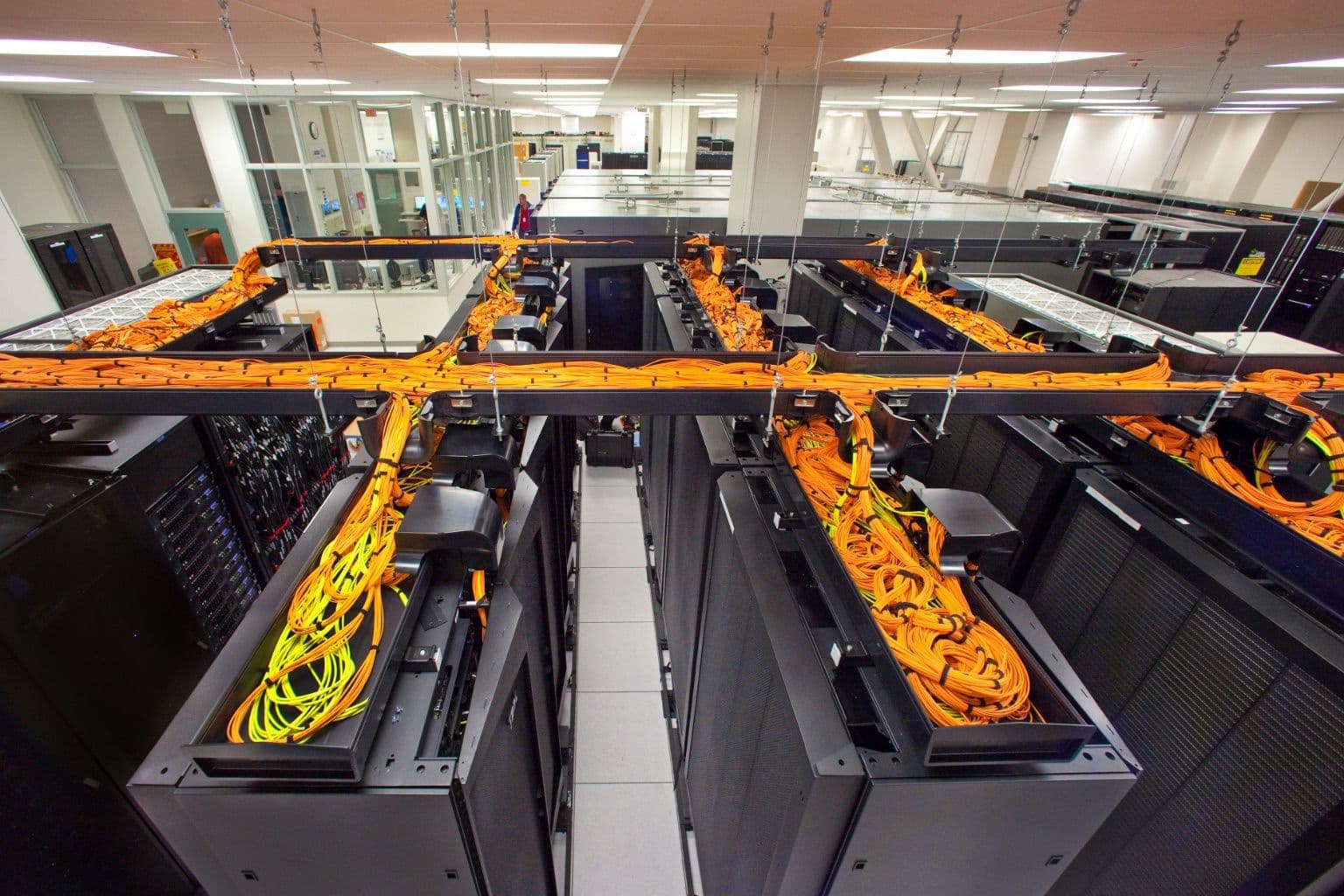
Cover photo: U.S. Department of Energy - Science - 391 004 010 (9522400937), via Wikimedia Commons (Public domain).