Cisco Catalyst Switches Explained for UK Networks: 9200, 9300, 9500 and the Rest
Cisco Catalyst switches come in a family of series that each do one job in a network. In the current Catalyst 9000 line, the 9200 and 9300 are fixed access switches for the edge where users plug in, the 9400 is a modular chassis for large access closets, and the 9500 and 9600 are core switches. The Catalyst 1000 sits below all of them for small offices. Choosing well means placing each series in the right layer, choosing a stacking method, and understanding the licence you must buy with the hardware. This guide covers all three for a UK network.
Where each Catalyst 9000 series sits
Cisco's own Catalyst 9000 overview page positions each series by role and form factor. In summary:
| Series | Cisco's positioning | Form factor |
|---|---|---|
| Catalyst 9200, 9200CX | Access for small branches and midsize campuses | Fixed, stackable (9200CX is compact and does not stack) |
| Catalyst 9300, 9300X | Access for business critical branches and campuses | Fixed, stackable |
| Catalyst 9400, 9400X | Access for midsize and large campuses | Modular chassis |
| Catalyst 9500, 9500X | Core for midsize and large campuses | Fixed |
| Catalyst 9600, 9600X | Core for midsize and large campuses | Modular chassis |
Cisco's page does not assign a series to the distribution layer. In a classic three tier design that role normally falls to whichever switches aggregate the access closets, which in a Catalyst network often means a 9500 pair or a stack of higher end 9300X units. In smaller UK offices the distribution and core layers are usually collapsed into one pair of switches, which keeps the design simpler and the bill shorter.
Catalyst 9200: the entry access switch
The Catalyst 9200 data sheet calls it an entry level access switch for campus and branch deployments. The details that matter when you size one:
- Stacking. Modular uplink C9200 models use StackWise-160 at 160 Gbps; fixed uplink C9200L models use StackWise-80 at 80 Gbps. Either way, up to eight members in a stack, up to 384 access ports, and you cannot mix C9200 and C9200L in one stack.
- Power over Ethernet. 802.3at PoE+ at up to 30 W per port, with a maximum of 1440 W of PoE+ power per switch. The multigigabit 9200CX models reach 60 W per port.
- Uplinks. The C9200 takes network modules from 4 x 1G up to 2 x 40G; the C9200L has fixed uplinks of 4 x 1G, 4 x 10G or 2 x 25G depending on the model.
- The compact 9200CX. Fanless models with 2 x 10G SFP+ uplinks, intended for spaces outside the wiring closet. The data sheet is explicit that stacking is not available on them.
For a typical floor of desks, phones and access points, a 9200 is often enough. Our catalogue lists 24 and 48 port models such as the C9200-24P-E; send us the full part number you are considering and we will confirm its uplinks and licence tier from Cisco's ordering guide.
Catalyst 9300: the stackable workhorse
Cisco describes the 9300 as its lead stackable enterprise access platform. It costs more than a 9200 and earns it in three places.
- Stack bandwidth. StackWise-480 at 480 Gbps on the C9300, StackWise-1T at 1 Tbps on the C9300X, and StackWise-320 on the fixed uplink C9300L and C9300LM. All of them stack up to eight members.
- StackPower. On modular uplink models, up to four switches can share power supplies in a StackPower stack, or eight with an external XPS-2200 unit. A failed power supply in one switch then draws on the others instead of dropping ports.
- PoE headroom. The C9300 H models provide Cisco UPOE+ at 90 W per port, which matters for high power access points, lighting or displays.
- Uplinks. Modular uplinks from 1G to 100G; the 9300LM has fixed 4 x 25G.
The 9300 data sheet also notes a Meraki cloud managed software option for certain models, which is useful if your organisation is moving towards dashboard management. The C9300-24H-A in our catalogue is one of the H models.
Catalyst 9400, 9500 and 9600: chassis access and the core
Above the fixed access switches the family changes shape.
The 9400 is a modular chassis for large access closets. It suits a closet where line cards in one chassis are easier to manage and power than a long run of separate fixed switches, typically on a big single building or campus.
The 9500 is a fixed core switch. It aggregates uplinks from the access layer and links to servers, firewalls and the internet edge. It is commonly deployed as a pair so the core has no single point of failure.
The 9600 is the modular core chassis for the largest campuses. Cisco's licensing table shows it supports only the Advantage licence tiers.
The X variants across the range (9300X, 9400X Supervisor Engine 2, 9500X and 9600X Supervisor Engine 2) support an optional HSEC licence, which Cisco's licensing white paper says enables WAN MACsec and IPsec configuration. Most office networks will not need it; it matters if a switch terminates encrypted links between sites.
How Cisco Catalyst switches are licensed
Licensing is the part of buying Cisco Catalyst switches that confuses most people, because there are two layers and two naming schemes in circulation. Cisco's Catalyst 9000 licensing white paper, updated in July 2026, sets out the base model:
| Licence | Type | What Cisco says |
|---|---|---|
| Network Essentials, Network Advantage | Perpetual | Right to use for an indefinite period, locked to the device, a mandatory one time purchase with the product |
| Cisco DNA Essentials, DNA Advantage | Subscription | Valid for 3, 5 or 7 years and purchased with the product |
| HSEC | Optional add on | Enables WAN MACsec and IPsec on supported X models |
The Catalyst 9200 data sheet adds that the DNA tier must match the Network Essentials or Network Advantage licence, and Cisco's configuration guide notes that pairing Network Advantage with DNA Essentials is only offered at renewal, not on first purchase.
There is a newer scheme as well. The current Catalyst 9300 data sheet describes unified Cisco Switching Essentials and Advantage licences bought through the Cisco Networking Subscription, with a standard minimum term of 36 months for new subscriptions, alongside the older DNA option. Ask any supplier which scheme a quotation uses, because the renewal conversation three years later depends on it.
On the software side, the white paper says Smart Licensing Using Policy is the default and only licensing model from IOS XE 17.3.2 onwards. That matters if you buy used or refurbished switches; our article on Cisco Smart Licensing and used hardware explains the transfer questions.
Where the Catalyst 1000 fits for small offices
Not every site needs the 9000 family. Cisco's Catalyst 1000 data sheet positions it as fixed managed Layer 2 switches for small businesses and branch offices. It runs Cisco IOS with a command line and an on box web interface, and up to eight Gigabit models can be managed as one unit through their uplinks under a single IP address. The 48 port PoE+ models provide up to 740 W of PoE budget at up to 30 W per port. Cisco gives the range an enhanced limited lifetime warranty with next business day hardware replacement where available.
For a small UK office with one comms cabinet and no plans for network access control, a C1000 such as the C1000-24P-4G-L covers the basics without a subscription to renew. If you are weighing it against the newer Catalyst 1200 and 1300 or Meraki, those are better compared side by side, and the trade offs are mostly about management rather than speed.
Choosing Cisco Catalyst switches for a UK site
A short way to land on the right series:
- Count the access ports per closet and the PoE draw per closet. If one closet needs more than a full stack of fixed switches, look at the 9400.
- Decide whether you need StackPower or UPOE+. If yes, it is a 9300. If not, a 9200 usually covers it.
- Decide the core. One closet with a firewall above it rarely needs a separate core. Several closets, servers on site, or a campus means a 9500 pair.
- Choose the licence tier. Network Essentials suits most access switching. Network Advantage is needed for some advanced routing and segmentation features; check the Cisco feature navigator for the exact feature you plan to use.
- Check the partner and support route. Cisco retired its Gold, Premier and Select partner tiers in January 2026 in favour of the Cisco 360 programme; our guide to checking a Cisco partner in 2026 explains what to ask now.
Four specification mistakes that delay Catalyst projects
Most problems with a Catalyst order are not about picking the wrong series. They are about the parts around the switch that nobody listed.
- Missing optics and modules. A modular uplink switch ships with an empty slot or a blank unless a network module is ordered, and SFP or SFP+ ports need transceivers that match the fibre or copper at the other end. List the module, the optic type and the fibre type (single mode or multimode) on the order.
- PoE budget versus power supply. The PoE figure on a data sheet is a ceiling. What a switch can actually deliver depends on the power supplies fitted, so check the power table in the data sheet against the supplies on your quotation.
- Stacking parts. Stack cables, and on some fixed uplink models a stack kit, are separate items. A closed stack ring needs one cable for each member, so count them per stack.
- Software consistency. Plan to run the same IOS XE release on every member of a stack and across switches in the same role, and record it. Mixed releases are a common cause of a new stack refusing to form on installation day.
None of these is difficult, but each one can add a week if it is found when the boxes are opened in the comms room rather than when the quotation is checked.
Buying Catalyst switches from Dubai for a UK network
Codeeo Tech is a Dubai reseller. We are not a Cisco partner, we have no UK office or UK stock, and a UK order ships from Dubai. Before ordering, settle these points:
- Duty and VAT. When we checked the UK Trade Tariff entry for 8517 62 00 00 in October 2026, it showed a third country duty of 0% and import VAT at 20%. Your customs agent confirms the code.
- WEEE. GOV.UK guidance treats a business that imports electrical equipment into the UK on a commercial basis as a producer with registration duties. That matters if you import to resell.
- Marking and power. GOV.UK says the UK continues to recognise CE marking alongside UKCA under the Product Safety and Metrology (Amendment) Regulations 2024. Ask for UK power cords on the quotation.
- Licence registration. Make sure licences are registered to your organisation's Cisco Smart Account, not the seller's.
FAQ: Cisco Catalyst switches
What is the difference between the Catalyst 9200 and 9300?
Both are stackable access switches. The 9300 adds faster stacking (480 Gbps or 1 Tbps against 80 or 160 Gbps), StackPower on modular models, UPOE+ at 90 W per port on H models, and faster uplinks up to 100G.
Can I mix 9200 and 9300 switches in one stack?
No. Each series uses its own StackWise technology, and Cisco's data sheet says even C9200 and C9200L cannot be mixed.
Is the Cisco DNA subscription mandatory?
Cisco's white paper says DNA subscriptions are purchased with the product for 3, 5 or 7 years, while the perpetual Network licence is the mandatory one time purchase. Newer orders may use the Cisco Networking Subscription instead; ask which applies.
Do I need a 9500 core for a small office?
Usually not. A single closet with a firewall above it can run a collapsed design on access switches. A core pair becomes worthwhile with several closets or servers on site.
Can Codeeo Tech ship Catalyst switches to the UK?
Yes, we quote with delivery to a UK address. The goods come from Dubai, so import VAT and any duty apply.
What to send with a Cisco Catalyst enquiry
- Port count per closet, split into PoE and non PoE, and the devices on PoE.
- Uplink speed needed to the core or firewall, and copper or fibre.
- Whether you want stacking, and how many members.
- Licence tier and term, or the features you need so we can suggest one.
- The UK delivery address and whether you prefer new or refurbished.
Every switch in the Codeeo Tech Cisco range is priced through Add to Quote. Send those details through the contact page and the reply will confirm the models, the licence scheme on the quotation, and the shipping route to your UK site.
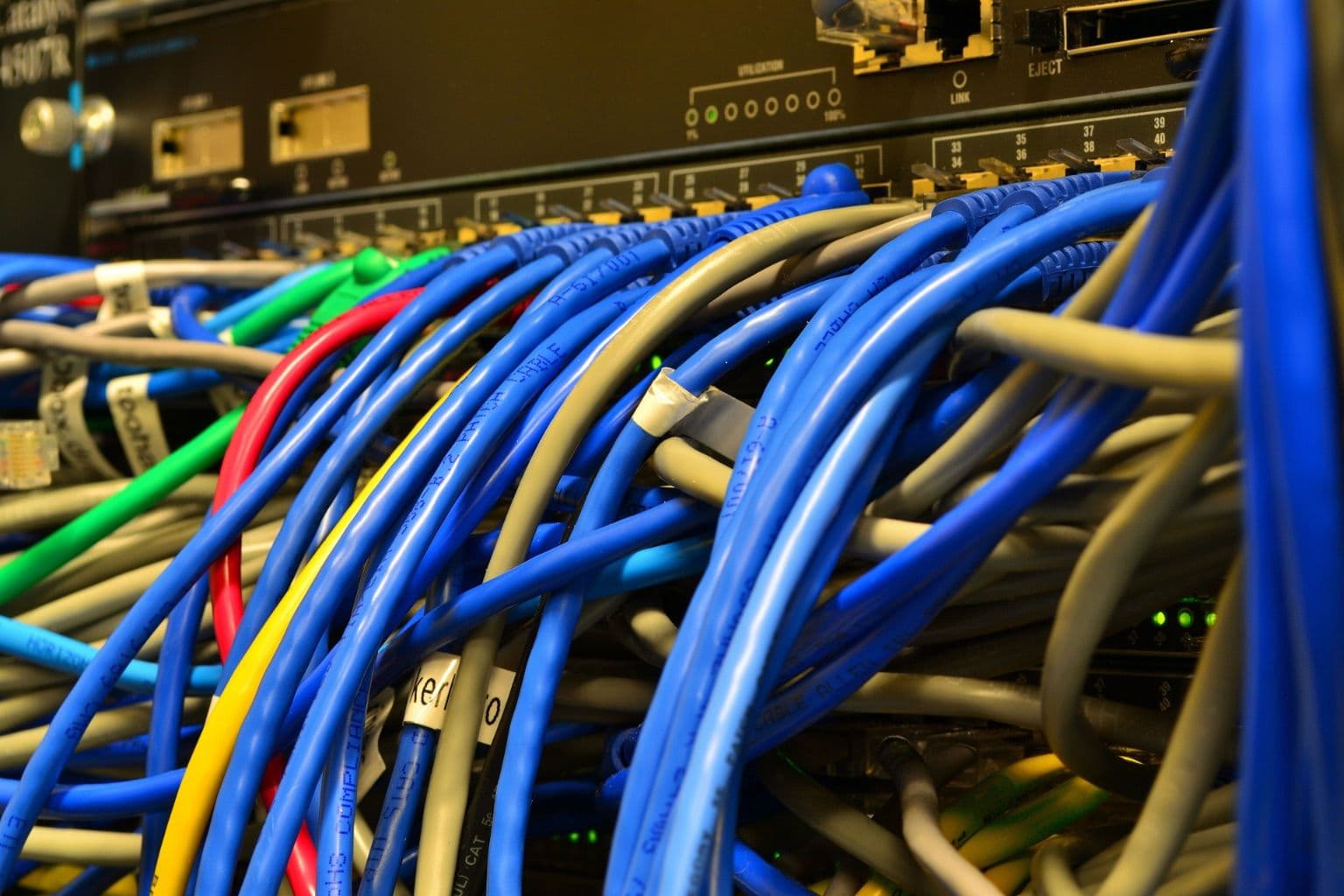
Cover photo: EthernetSwitch2, via Wikimedia Commons (CC0).