Power Distribution Units: Basic, Metered or Switched
A rack PDU is the strip of outlets your servers and switches actually plug into, and the three tiers differ in only two ways: how much the unit tells you, and how much it lets you do from a browser. Basic distributes power and nothing else. Metered reports what the unit is drawing so you can see how close you are to the breaker. Switched adds remote control of individual outlets, so a hung appliance in Jebel Ali can be power cycled without anyone driving there at 2am.
The decision is not about brand or outlet count. It turns on whether you need to prove in numbers what a rack is consuming, and whether you need to cut power to one device remotely. If neither applies, a basic unit is the correct purchase and the money saved is better spent on the UPS behind it.
What each tier actually does
A basic PDU is a bar of outlets with an inlet cord and usually a set of circuit breakers. The APC NetShelter Basic Rack PDU listed in vertical format at 220 to 240 V, 32 A with 20 C13 and 6 C19 outlets carries no display and no network port. It cannot tell you it is at 90 percent of capacity, and it will not warn you before a breaker trips.
A metered PDU adds measurement at the unit or the circuit, usually with a local display and an Ethernet port. Schneider Electric describes the function on the AP8959 as current metering that provides real time remote monitoring of connected loads, with user defined alarms that warn of potential circuit overloads before critical IT failures occur. That alarm is the feature worth paying for, because it moves you from discovering an overload to being told about one.
A switched PDU can turn individual outlets on and off over the network and sequence them at startup. The important distinction buyers miss is that switching and per outlet measurement are sold separately. A unit badged Switched may control outlets while metering only the whole unit. The variant that measures every outlet individually is badged Switched Metered Outlet, as on the APDU11150SM, and that is the tier to specify if you must report what one server in a shared rack consumed last month.
Four real units at the same 230 V, 32 A rating
Comparing tiers is easier when the electrical rating is held still. These four are all single phase at 230 V with a 32 A class inlet, read from Schneider Electric product pages for the UAE on 2 October 2026.
| Model | Tier | Capacity | Outlets | Measures | Remote switching |
|---|---|---|---|---|---|
| NetShelter Basic Rack PDU, vertical | Basic | 220 to 240 V, 32 A | 20 C13, 6 C19 | Nothing | No |
| AP8853 | Metered, 0U | 7.4 kW, 230 V, 32 A | 36 C13, 6 C19 | Whole unit | No |
| APDU11150ME | Advanced Gen 2, Metered | 7.4 kW, 230 V, 32 A | 40 combination | Whole unit | No |
| APDU11150SM | Advanced Gen 2, Switched Metered Outlet | 7.4 kW, 230 V, 32 A | 40 combination | Every outlet | Yes |
Two details in that table change how a rack gets built. The AP8853 splits its 42 outlets into fixed types, 36 C13 and 6 C19, so six is the hard ceiling on 16 A devices in that rack. The Advanced Gen 2 units instead use what Schneider calls a 4-in-1 combination outlet design that acts as C13, C15, C19 and C21 in one outlet, which removes the guess about how many C19 loads you will own in three years.
The inlet decides the installation, not the outlets
DEWA gives the nominal supply in its Regulations for Electrical Installations as 230 or 400 V with a tolerance of plus or minus 10 percent, at 50 Hz, three phase and four wire. A single phase 32 A rack PDU therefore lands on a 230 V circuit while a three phase unit such as the AP8886, rated 22 kW with 30 C13 and 12 C19 outlets on an IEC 309 3P, N and E cord, needs a three phase feed at the rack. Ordering the wrong one is a procurement error no amount of rack work will fix.
The inlet connector matters as much as the voltage. The AP8853 ships with an IEC 309 2P and E cord, and the Advanced Gen 2 units use a 332P6 inlet. IEC 60309-2:2021, the fifth edition, covers industrial plugs, socket outlets and appliance inlets up to 1000 V AC and 125 A. In a Business Bay or JLT fit out that means someone has to install a matching industrial socket before the PDU is useful, and that is the landlord's electrician rather than your IT contractor.
Nameplate current is not usable current
Nameplate current and usable current are different numbers, and the datasheets say so. The product datasheet for the AP7800B, dated 23 August 2026, lists an input current limit of 15 A alongside a line rated current of 12 A and a maximum total current draw per phase of 12 A. That is 80 percent of the inlet rating, and the 1440 VA load capacity on the same sheet is calculated from the 12 A figure, not the 15 A one.
Plan against the lower number. Twenty servers at a measured 300 W each is 6 kW, which looks comfortable against a 7.4 kW unit until you add the switches, the firewall and the inrush when everything restarts together. The same discipline applies one layer up, where the watt rating of the UPS is the real ceiling rather than the VA headline, as set out in reading a UPS nameplate properly.
Metering accuracy is a published number
If the reason for buying a metered unit is to cross charge a tenant or settle an argument about which department is filling the rack, check the tolerance. Schneider publishes plus or minus 3 percent metering accuracy for amps, volts, kW and kWh on the AP8853. On a 6 kW rack that is a band of roughly 360 W, which is fine for spotting a trend and too loose to put on an invoice without saying so.
Before accepting a quotation that simply says metered, ask for the accuracy figure in writing next to the model number, the same way you would check every other line on an enterprise hardware quotation. Two units that both say metered can differ by several percentage points.
What switched outlets fix, and what they do not
Remote switching earns its cost in exactly one situation: a device that locks up and recovers on a power cycle, sitting somewhere nobody can reach quickly. A branch office in Dubai Silicon Oasis with no on site IT is the standard case. Outlet sequencing at startup is the second benefit, because bringing a storage array up before the hosts that mount it avoids a manual cleanup after every outage.
What switching does not do is replace out of band management. An iDRAC or iLO card resets a hung operating system cleanly, while cutting the outlet is abrupt power removal with the filesystem risk that implies. Treat it as the last resort after the management card fails to respond, and check that outlet labelling matches reality, because switching off outlet 14 believing it is the test box when it is the firewall is a self inflicted outage. Pair it with the alerting in monitoring that tells you before users do.
Heat is the UAE specific variable
Appliance couplers are rated for temperature, and the standard treats heat as a special case. IEC 60320-1:2021, Edition 4.0, published on 27 July 2021, sets the general requirements for appliance couplers and includes particular requirements for couplers intended for elevated ambient temperatures above 35 degrees Celsius. That threshold is ordinary for a Dubai comms room that loses cooling on a July weekend.
The equipment side is rated too. The AP7800B datasheet gives an operating ambient range of minus 5 to 45 degrees Celsius. A small room packed with kit can pass 45 within hours of an air conditioning failure, and the PDU is one of the few components with no fan and no alarm of its own unless it is a metered model with a temperature probe. That is a real argument for the metered tier in the UAE that has nothing to do with billing. Keeping the room survivable in the first place is covered in comms room housekeeping.
Specifying one so the quotes compare
Give any supplier six things and the quotations become comparable: phase and voltage, inlet connector type, total load in watts measured rather than estimated, the count of C13 and C19 devices you own today, whether you need per outlet measurement or only unit level, and whether you need remote switching. Leave any of those out and you will receive three quotes for three different products.
Mount matters as well. A 0U vertical unit such as the AP8853 runs the full height of the rack and costs no rack units, which is why it suits a dense cabinet, while a horizontal 1U or 2U unit is easier to reach in a half populated wall mounted rack. Decide that before the order, because changing it afterwards means recabling the whole rack. You can see the APC equipment Codeeo Tech lists on the APC category page, and every item on the site is quoted rather than priced, so send the six points above through the contact form and ask what fits.
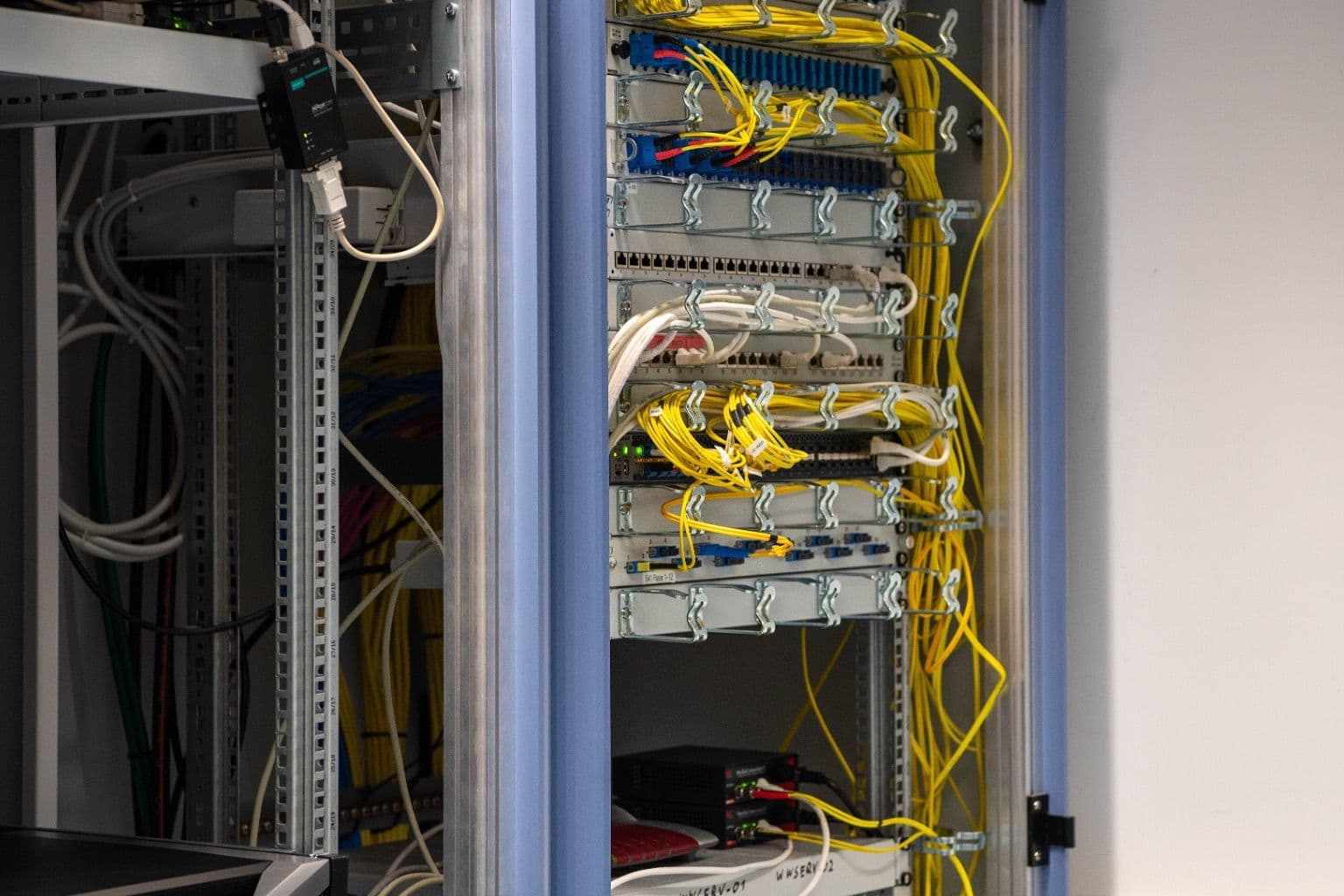
Cover photo: Spangdahlem AB becomes first DoD installation to implement BlastWave cyber security solution (8296220), via Wikimedia Commons (Public domain).