Rack UPS or Tower UPS for a Small Server Room
If your servers and switches already live in a 19 inch cabinet with spare depth and a sound load rating, buy a rack UPS and mount it at the bottom. If the kit sits on a shelf, a desk or the floor of a cupboard, or the only cabinet you have is a shallow wall mount, a tower UPS is usually the better buy, and it often gives you more outlets for the same rating. The choice is decided by three numbers you can read off datasheets before you order: depth, weight and outlet count.
What follows uses APC Smart-UPS datasheets downloaded from Schneider Electric's UAE site on 28 September 2026, because the tower and rack versions of the same range make the trade-offs easy to see side by side.
The same rating, two very different boxes
Take the 1500 VA Smart-UPS in both shapes. Both are rated 1500 VA and 1000 W, both are line interactive with a sine wave output, and both are listed for 0 to 40 °C operation. After that they diverge more than most buyers expect.
| Datasheet line | SMT1500I (tower) | SMT1500RMI2U (rack, 2U) |
|---|---|---|
| Output outlets | 8 x IEC C13 | 4 x IEC C13 |
| Height x width x depth | 219 x 171 x 439 mm | 86 x 432 x 457 mm |
| Product weight | 24.09 kg | 28.64 kg |
| Replacement battery | RBC7 | APCRBC159 |
| Rails in the box | Not rack mountable | Rack mounting support rails listed |
| Mounting preference | No preference | Lower |
Two lines on that table catch people out. The rack unit has half the outlets, so a small room with two servers on dual power supplies, a firewall, a core switch and a NAS runs out of sockets before it runs out of watts. The rack unit is also 4.55 kg heavier, because the batteries are laid out flat across a 432 mm chassis instead of stacked in a narrow tower.
Depth is where wall cabinets fail
Many small offices in Business Bay, JLT and Dubai Silicon Oasis do not have a floor standing 42U rack. They have a wall mounted cabinet in a cupboard next to the pantry. That is where the rack UPS decision usually goes wrong, and the reason is depth rather than height.
APC's own 12U wall cabinets show the problem clearly. The AR112SH4, sold as switch depth, is 400 mm deep overall with a maximum mounting depth of 328.9 mm. The AR112SH6, sold as server depth, is 600 mm deep with a maximum mounting depth of 528.3 mm. Now compare the UPS depths:
- SMT1500RMI2U at 457 mm fits the 600 mm cabinet and does not fit the 400 mm one.
- SMX1500RMI2U at 490 mm, a 1500 VA and 1200 W rack or tower convertible unit, fits the 600 mm cabinet with 38 mm to spare for the rear power cord.
- SMT3000RMI2U at 683 mm fits neither. It needs a floor standing rack.
The 3000 VA rack model is the trap. A buyer sees 2U on the spec sheet, counts free space in a 12U wall cabinet and orders it. Height was never the constraint. Before you ask for a quote on any rack UPS, measure the distance between the front and rear mounting rails in your cabinet, subtract room for the power cord bend, and compare it with the UPS depth on the datasheet.
Weight belongs at the bottom, and it counts against the cabinet
Every rack UPS datasheet in this comparison lists the mounting preference as "Lower". That is not cosmetic. A 28 kg or 44 kg box mounted high in a cabinet raises the centre of gravity, and in a wall cabinet it increases the pull on the wall fixings.
The AR112SH6 wall cabinet carries a permanent permissible load of 90.7 kg static. Put an SMT1500RMI2U in it and you have used 28.64 kg, just under a third of the rating, before a single switch, patch panel or small server goes in. Add a 1U server and a 24 port PoE switch and the margin shrinks quickly. The cabinet rating also assumes a wall that can hold it. Many office fit outs in Dubai towers use gypsum partitions, and a 90 kg load on gypsum board needs a proper backing plate or a solid wall. That is a question for your fit out contractor before the UPS arrives, not after.
A tower UPS on the floor beside the cabinet removes that load from the wall entirely. For a 6U or 12U wall cabinet holding switches and a firewall, this is often the sensible arrangement: tower on the floor, a short C13 to C14 lead or a small PDU up into the cabinet.
Outlets, and the dual power supply problem
Count every power cord before you choose. Many rack servers are ordered with two redundant power supplies, and each one needs its own socket if you want the redundancy you paid for. Two servers alone use all four outlets on an SMT1500RMI2U.
The honest options are a UPS with more outlets, a rack PDU fed from the UPS, or two smaller UPS units so each power supply sits on a different one. The third option is the only one that keeps a server running if one UPS fails or is taken offline for a battery swap. The larger SMX3000HVNC, a 3 kVA rack or tower convertible 4U unit, lists 8 x C13 plus 2 x C19 outlets and weighs 38.64 kg, which is the kind of unit that suits a floor standing rack rather than a wall cabinet.
Heat, noise and where people sit
Both shapes are rated to the same ambient ceiling on these datasheets: 0 to 40 °C for the SMT and SMX3000 models, and 0 to 45 °C for the SMX1500RMI2U. In a UAE summer, a comms cupboard whose fan coil unit is switched off overnight or over the weekend can approach that ceiling, and battery life suffers well before the UPS alarms. That is covered in detail in UPS battery replacement cycles in UAE conditions.
Where the form factor matters is airflow. A rack UPS breathes front to back like the servers around it, which suits a cabinet with a vented door and blanking panels. A tower UPS pushed into the back corner of a store room recirculates its own warm air. Neither shape fixes a hot room. Noise is similar on paper: 45 dBA for the SMT1500I and 46 dBA for the SMT1500RMI2U, rising to 53 and 55 dBA for the 3 kVA models. If the "server room" is a corner of an open plan office in DIFC, the 3 kVA units will be heard.
Batteries and serviceability
The rack and tower versions take different battery cartridges: RBC7 for the SMT1500I, APCRBC159 for the SMT1500RMI2U, and APCRBC115 for the SMX1500RMI2U. Record the cartridge part number in your asset register on the day the UPS goes in, because a replacement quote needs it and the label is hard to read once the unit is racked. The SMT1500RMI2U datasheet lists a battery life of 4 to 6 years against 3 to 5 years for the tower, but both figures assume a cool room, and a Dubai comms cupboard is rarely that.
Also check the product status. The SMT3000I tower datasheet pulled on 28 September 2026 is marked discontinued, while the SMT3000RMI2U rack version is not. Ranges get retired at different times by form factor, so confirm the status of the exact part number you are standardising on, especially if you want identical units across two offices.
When a convertible unit is the right answer
Convertible models ship with both rails and removable feet. The SMX1500RMI2U lists rack mounting support rails and removable support feet in the box. That suits a business that runs a tower today in a Jebel Ali warehouse office and expects to move into a proper cabinet within two years. It is a reasonable hedge, provided the depth and outlet count still work in the room you have now.
A quick decision rule
- Measure the usable depth between your cabinet rails. If it is under about 460 mm, a 1500 VA rack unit is marginal and a 3 kVA rack unit will not fit.
- Add up everything already in the cabinet plus the UPS weight, and compare it with the cabinet's static load rating.
- Count power cords, including second power supplies, and compare with the outlet count on the datasheet.
- Size in watts first, then VA, using the method in VA or watts: reading a UPS nameplate properly.
- If any of the first three checks fails, buy the tower, or move to a floor standing rack.
Codeeo Tech supplies hardware rather than installation, so the measurements above are yours to take, and they are exactly what makes a quotation accurate. You can browse the Smart-UPS, Smart-UPS On-Line and Easy UPS On-Line listings, along with matching battery systems, under APC on the store. Every item is priced on request, so send your load in watts, rail depth, cabinet rating and outlet count and the quote comes back matched to the room. For keeping that room healthy afterwards, see comms room housekeeping that prevents outages.
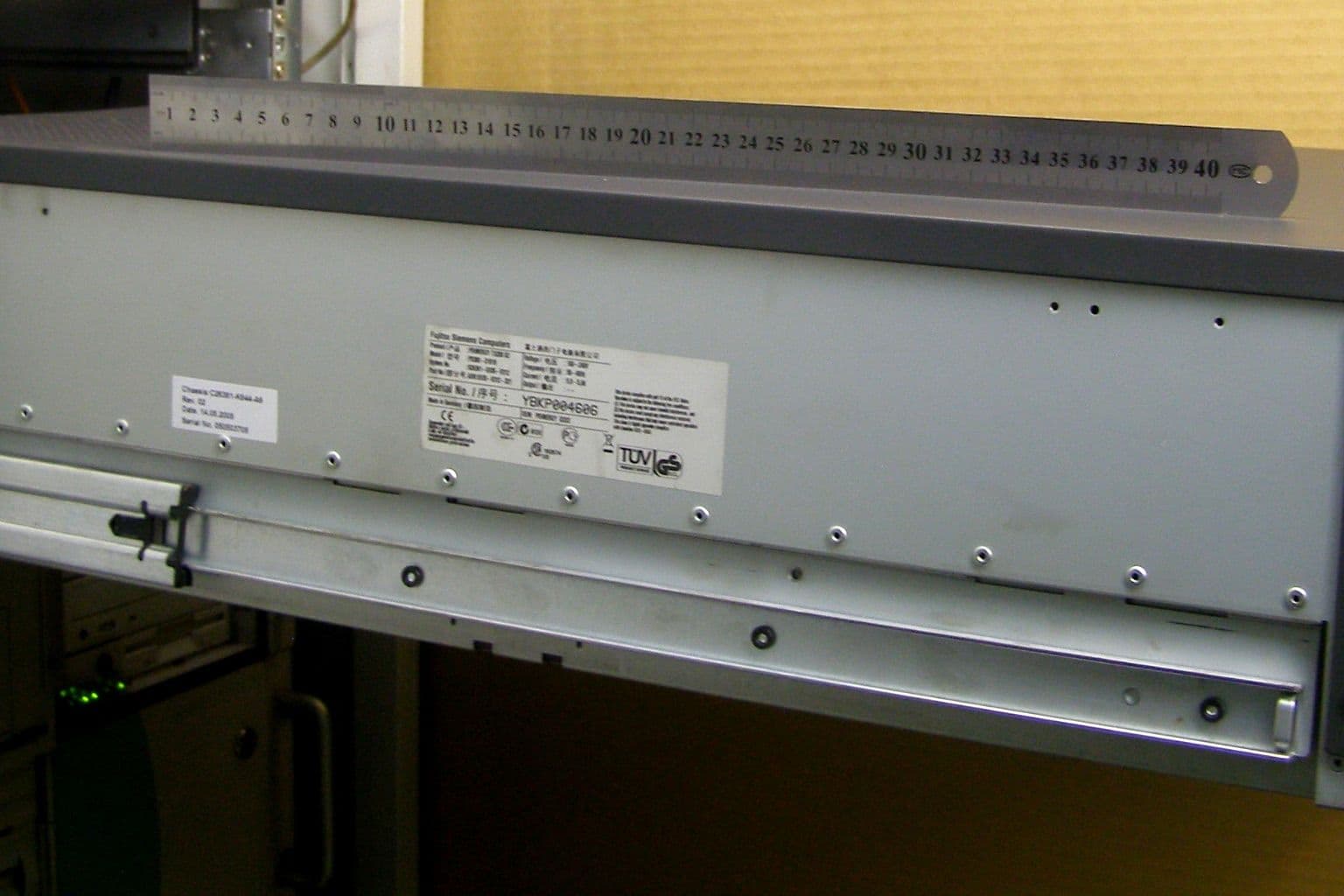
Cover photo: Fujitsu Siemens 19inch rack rail system 20100621, via Wikimedia Commons (Public domain).