Cooling a Comms Room in Dubai Summer Conditions
A comms room in Dubai needs its own cooling, running 24 hours a day, sized from the measured load of the equipment rather than the size of the room, with an outdoor unit rated for 46°C ambient and a temperature alarm that someone actually receives. The building's comfort air conditioning is not a cooling plan. Schneider Electric's White Paper 68 on cooling IT wiring closets puts the typical vendor maximum for active network equipment at 40°C and the vendors' own recommended range at 21°C to 24°C, and it warns that a UPS battery held at 40°C lasts 1.5 years or less against the usual 3 to 5 years. In a city where the National Center of Meteorology forecast 47°C inland and 39°C in Dubai on 2 July 2026, that gap closes fast.
Start with the heat load, not the floor area
Every watt an IT device draws from the mains comes back out as heat. Schneider Electric's White Paper 25, Calculating Total Cooling Requirements for Data Centers (Revision 3, Neil Rasmussen), states that the thermal output of IT equipment in watts simply equals its power consumption in watts, and gives the conversions: 1 watt is 3.41 BTU per hour, and one ton of cooling is 3,530 watts. The same paper adds the non-IT heat: a UPS contributes 0.04 times its rated power plus 0.05 times the IT load, power distribution adds 0.01 times the rating plus 0.02 times the IT load, and lighting adds 14.32 watts per square metre.
Worked through for a typical Business Bay tenant room: 3,000 watts of measured IT load, a 5,000 watt UPS and a 3 metre by 3 metre floor. The UPS adds 350 watts, distribution 110 watts and lighting 129 watts, for a total near 3,590 watts, which is 12,240 BTU per hour or just over one ton before any margin. Sizing from nameplate labels instead buys two or three times too much. White Paper 68 gives the reason: configurable routers with nameplate ratings of 5 to 6 kW only draw 1 to 2 kW in common configurations. Measure at the UPS output.
Why the building's air conditioning will let you down
Comfort cooling is designed for people, and White Paper 68 quantifies the mismatch: most comfort systems deliver 43 to 54 watts per square metre, roughly 150 watts per rack. The thermostat sits in the open office, not in the comms room, so the system cycles against the needs of the people outside, and the paper notes that the resulting swings stress IT equipment more than a steady higher temperature does.
The weekend setback is what catches Dubai tenants. White Paper 68 models a sealed 3 by 3 by 3 metre closet relying on conduction through its walls into a 20°C office. It can hold 400 watts below 25°C, or 1,000 watts below 32°C. If the building sets back to 29°C over the weekend, a 9°C rise, the critical closet can support no load at all and the non-critical one only 250 watts.
District cooling makes this more confusing, not less. Empower, the Emirates Central Cooling Systems Corporation, reported on 17 September 2024 that it finished the 2024 summer with zero service interruptions, and its campaign that year asked customers to set thermostats to 24°C. That tells you chilled water reached the building. It says nothing about whether your landlord runs the fan coil units on your floor after 7pm or over Eid. Before you sign a fit-out drawing, ask building management in writing for the hours and set points outside office hours. If the answer is a night setback or a shutdown, the white paper's weekend example is your room, whether the tower is in DIFC, Business Bay or JLT.
What the equipment itself will tolerate
Three ceilings apply in one rack, and you design to the lowest. The HPE ProLiant DL380 Gen11 QuickSpecs give a standard inlet range of 10°C to 35°C at sea level, with performance possibly reduced above 30°C or with a fan fault. The 35°C to 40°C and 40°C to 45°C extended ranges apply only to approved configurations listed on HPE's ASHRAE page. A server assumed to be rated to 45°C usually is not, once the configuration is checked.
Network gear is more tolerant on paper. The Cisco Catalyst 9300 data sheet lists minus 5°C to plus 45°C up to 1,500 metres, plus a short-term exceptional range to 55°C capped at 96 consecutive hours, 360 hours in total, or 15 occurrences a year. A shutdown from Friday evening to Monday morning is about 60 hours, so if the room drifts past 45°C each time, six weekends use up the annual total. The UPS battery is the tightest ceiling: White Paper 68 says that where a UPS lives in the closet, an operating temperature below 25°C should be a requirement. Our note on UPS battery replacement cycles in UAE conditions covers what heat does to a lead acid string.
Ventilation or a dedicated air conditioner
White Paper 68 sets usable thresholds. For a critical closet, passive ventilation through grilles works below 700 watts, fan-assisted ventilation covers 700 to 2,000 watts, and above about 2,000 watts a dedicated air conditioner is recommended. For a non-critical closet the figures are 1,750 watts, 1,750 to 4,500 watts, and dedicated cooling above 4,500 watts.
Those numbers assume a cooler space next door to vent into. From June to September in Dubai the adjacent office is cool only while the building plant runs, and the paper's own setback example shows the closet rising in step with it. The rule that holds up on site: if the equipment must work through an empty weekend and the load is above about 1,000 watts, plan a dedicated split unit and treat ventilation as the backup.
Specifying the split unit for a Dubai rooftop
The outdoor unit is where summer specifications fail. Air conditioners are rated at standard test conditions, and the Air-Conditioning, Heating and Refrigeration Institute announced on 19 May 2021 that its certification programme had added T3 testing at 46°C outdoor dry bulb and a Kuwait T4 condition at 48°C, with operability tests at 52°C, alongside the standard T1 condition at 35°C. A unit sold on a T1 rating is being asked to work 11°C above its rated point on a Dubai afternoon, and on a flat roof in Jebel Ali or a south-facing wall in Al Quoz the air at the condenser coil is hotter than the forecast.
Five points for the specification. Capacity and efficiency stated at T3, not only T1. Two smaller units with a lead-lag controller that alternates them, so a compressor fault in August does not take the room down. Automatic restart after a power cut, which White Paper 68 calls for; a unit that returns in standby after a brief mains interruption leaves the room uncooled until someone notices, which on a Saturday can be 48 hours. A condensate drain with a trap and float switch, because the NCM forecast on 2 July 2026 had Dubai humidity between 30 and 65 per cent, and a unit pulling that moisture out of a sealed room all day produces real water. And the condenser out of direct sun with clear airflow, which rules out the enclosed service balconies some towers offer. The trade-off is cost: White Paper 68 is blunt that dedicated air conditioning costs far more than ventilation, and the reply in this climate is that ventilation only works while someone else's plant runs.
Power cuts and the UPS
When the mains drop, the UPS keeps the heat coming while the cooling stops. White Paper 68 draws the line at 10 minutes: under 10 minutes of runtime, the thermal mass of the air and walls holds the temperature. Beyond that, the cooling must stay on, and an air conditioner on a UPS needs 4 to 6 times its nominal current for compressor inrush, which means a much larger UPS and battery. The paper's practical alternative is a fan-assisted ventilation system on the UPS that starts when power fails and stops when the air conditioner restarts. Sizing that is covered in our guide to rack UPS versus tower UPS for a small server room.
The summer checklist
- Put a temperature and humidity sensor at the top front of the rack, where inlet air is warmest, and alarm it at 27°C to a phone. Our post on what monitoring tells you before users do covers the alerting side.
- Service the split units before June: filters, condensate line, refrigerant charge and the condenser coil.
- Fit blanking panels and seal cable cut-outs so cold air goes through the equipment, not around it. The measured effect is in our comms room housekeeping post.
- Test the weekend. Leave the room alone from Friday evening with the sensor logging and read the curve on Monday.
Where Codeeo Tech fits
Codeeo Tech is a hardware supplier at IFZA Business Park in Dubai Silicon Oasis. We stock the APC by Schneider Electric UPS and rack power lines that sit inside the room, a small precision cooling range, and the Cisco, HPE and Dell EMC equipment whose heat you are removing. Everything is quoted rather than list-priced, so send the measured load with your request. Browse the APC range or contact us with the load figures. Installing the air conditioning itself is a job for a licensed MEP contractor, and we can supply the equipment list they will ask for.
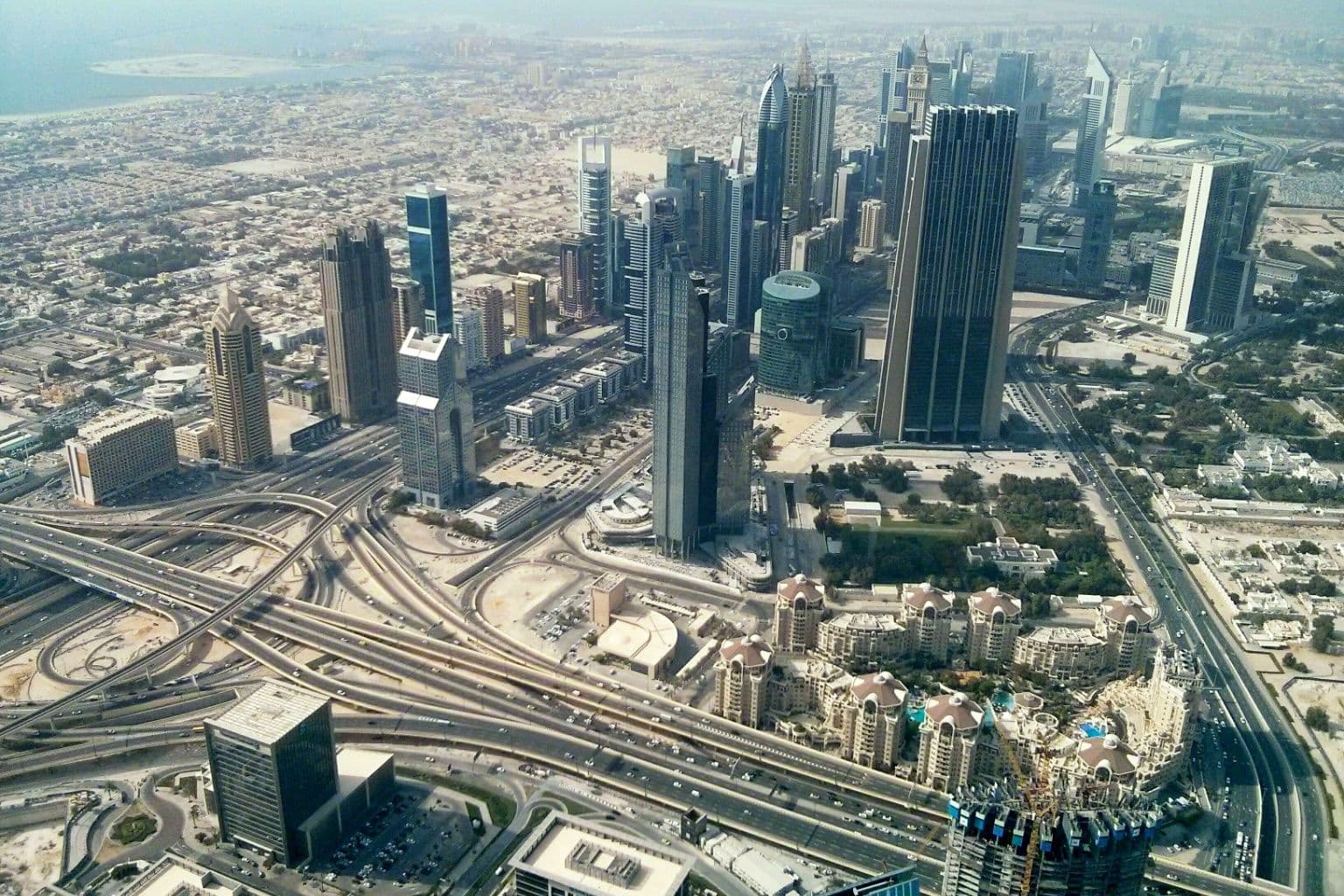
Cover photo: Dubai, United Arab Emirates (Unsplash XWKNM4TsWAQ), via Wikimedia Commons (CC0).